

Free 800-150 Exam Files Verified & Correct Answers Downloaded Instantly
Instant Download 800-150 Dumps Q&As Provide PDF&Test Engine
Cisco 800-150 Exam Syllabus Topics:
| Topic | Details |
|---|---|
| Topic 1 |
|
| Topic 2 |
|
| Topic 3 |
|
| Topic 4 |
|
| Topic 5 |
|
NEW QUESTION # 51
What is the purpose of the packages.conf file in Install mode on Cisco IOS XE Software supported switches?
- A. It determines which software packages need to be loaded and in what order during boot up.
- B. It is used to extract the bin file during the installation process.
- C. It contains the entire bundled software image in a single file.
- D. It is a subdirectory in flash memory where individual software packages are stored.
Answer: A
Explanation:
InInstall mode, thepackages.conffile plays a crucial role in the boot process of Cisco IOS XE Software. It specifies the list of software packages to be loaded and the sequence in which they should be initialized during system startup. This file ensures that all necessary components are correctly loaded, providing a modular and flexible approach to software management.
Contrary to the other options:
* Thepackages.conffile does not extract the bin file; it references already extracted packages.
* It does not contain the entire bundled image; that's characteristic of Bundle mode.
* While it resides in the flash memory, it is not a subdirectory but a configuration file.
Reference:Supporting Cisco Devices for Field Technicians (FLDTEC) - Cisco IOS Software Basics
NEW QUESTION # 52
Drag and drop the configuration tasks for restoring software from the left onto the corresponding commands on the right.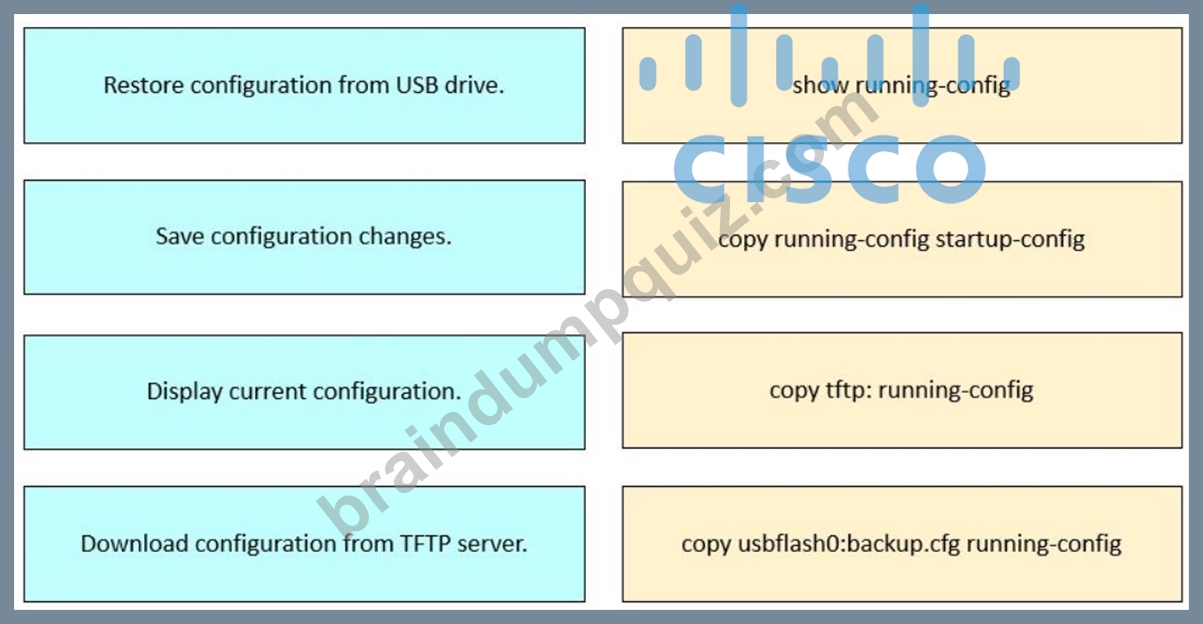
Answer:
Explanation: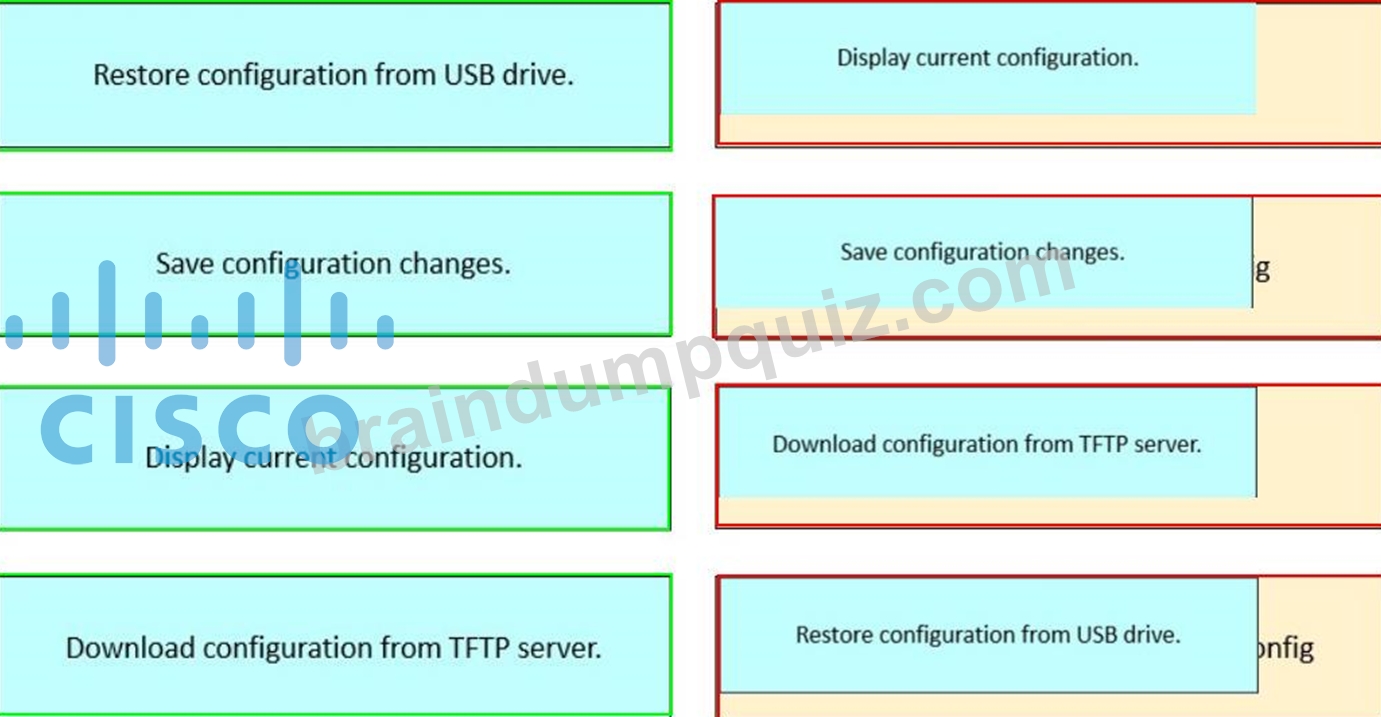
NEW QUESTION # 53
Which scenario would result in a speed mismatch when configuring Ethernet devices with different speed settings?
- A. One end is manually set to 100 Mbps, and the other end is set to auto-negotiation
- B. One end is manually set to 1 Gbps, and the other end is manually set to 100 Mbps
- C. Both ends are manually set to thesame speed
- D. Both ends are set to auto-negotiation and fail, reverting to their lowest speeds
Answer: B
Explanation:
A speed mismatch occurs when two connected Ethernet devices are configured to operate at different speeds.
In scenario A, one device is manually set to 1 Gbps, while the other is set to 100 Mbps. Since both ends are hard-coded to different speeds, they cannot successfully negotiate a common speed, leading to a mismatch and resulting in a failed or unstable link.
In contrast, scenario B, where both ends are manually set to the same speed, ensures compatibility and stable communication. Scenario C can lead to a duplex mismatch rather than a speed mismatch; the auto-negotiating end may default to half-duplex if it cannot determine the duplex setting of the manually configured end.
Scenario D is less common; if auto-negotiation fails, devices may revert to their lowest common speed, but this typically results in reduced performance rather than a complete mismatch.
Reference:Supporting Cisco Devices for Field Technicians (FLDTEC) - Troubleshooting Methodologies
NEW QUESTION # 54
Which command is used to determine if there is sufficient space in the memory of a device before installing a new Cisco IOS image?
- A. show memory
- B. show file-system
- C. show storage
- D. show flash:
Answer: D
Explanation:
The show flash: command is used to display the contents of the device's flash memory, which is where the Cisco IOS image is typically stored. By issuing this command, a technician can verify available space and determine whether there is enough capacity to accommodate a new IOS image before initiating an upgrade or image replacement process.
This command provides a detailed listing of files, their sizes, and the total and available memory space within the flash file system.
show file-system lists all available file systems but doesn't detail their content.
show memory shows runtime memory usage (RAM), not flash memory.
show storage is not a standard IOS command.
NEW QUESTION # 55
Which deployment model minimizes dependence on internet connectivity for core collaboration functions?
- A. Hosted Collaboration Solution
- B. Software-as-a-Service model
- C. On-premises deployment
- D. Cloud-based deployment
Answer: C
Explanation:
An on-premises deployment model minimizes dependence on internet connectivity for core collaboration functions. In this model, all critical services, including call control, messaging, and conferencing, are hosted within the organization's local infrastructure. This ensures that internal communication services remain operational even if internet connectivity is lost.
In contrast, cloud-based deployments (Options A and C) and Hosted Collaboration Solutions (Option D) rely on internet connectivity to access services hosted externally, making them more susceptible to internet outages.
NEW QUESTION # 56
When should a crossover UTP cable be used instead of a straight-through cable when connecting network devices?
- A. To connect electrically unlike devices
- B. To connect electrically like devices
- C. To connect a switch to a router
- D. To connect a PC to a wireless access point
Answer: B
Explanation:
A crossover UTP (Unshielded Twisted Pair) cable is used to connect two similar devices directly. This includes:
Switch to switch
Router to router
PC to PC
The crossover cable reverses the transmit and receive pairs, allowing for proper communication between like devices without the need for an intermediary device.
Conversely, a straight-through cable is used to connect dissimilar devices, such as:
PC to switch
Router to switch
PC to router
This cable maintains the same wiring on both ends, suitable for connecting different types of devices.
Therefore, when connecting electrically like devices, a crossover cable is appropriate.
NEW QUESTION # 57
Which two results are achieved by briefly pressing the restore/reset button on a Cisco Meraki switch? (Choose two.)
- A. Cloud management is disabled.
- B. The management interface is cleared.
- C. The device reboots.
- D. The downloaded configuration is deleted.
- E. A full factory restore is performed.
Answer: B,C
Explanation:
On a Cisco Meraki switch, briefly pressing the restore/reset button (typically less than 5 seconds) triggers:
A reboot of the device (Option A)
Clearing of the local management interface settings (Option D), which may include temporary network information such as DHCP leases or local overrides.
To perform a full factory reset (Option B), the button must be held down for a longer duration, usually more than 10 seconds. Options C and E do not reflect standard reset behavior.
NEW QUESTION # 58
Drag and drop the TFTP statements from the left onto the corresponding categories on the right.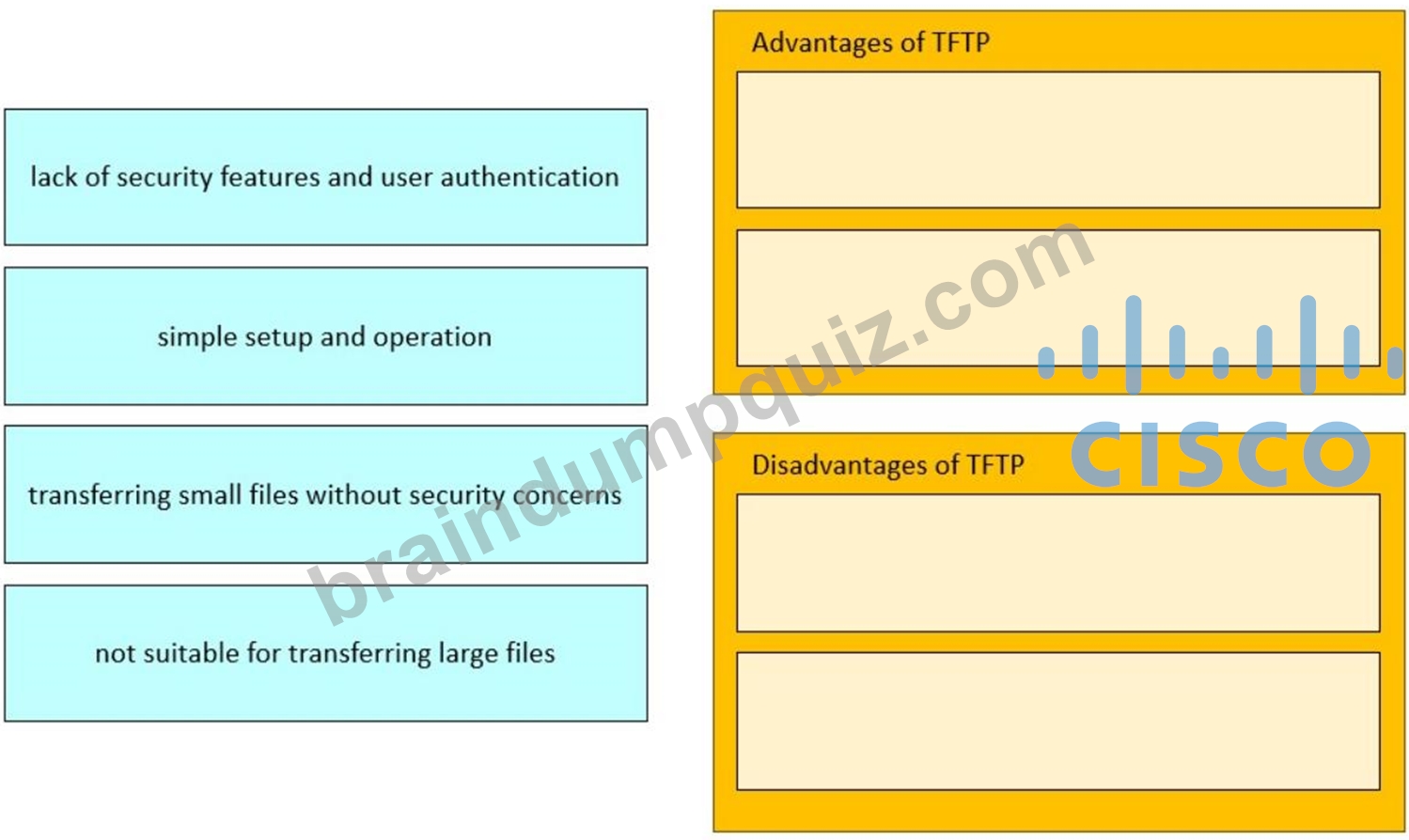
Answer:
Explanation: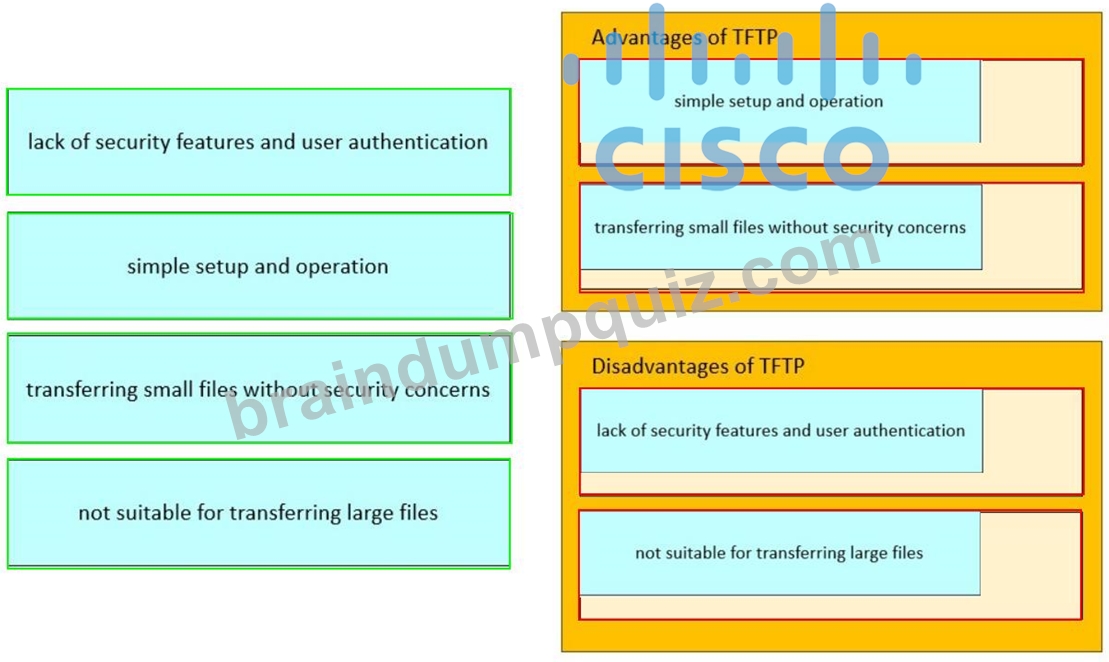
NEW QUESTION # 59
Refer to the exhibit.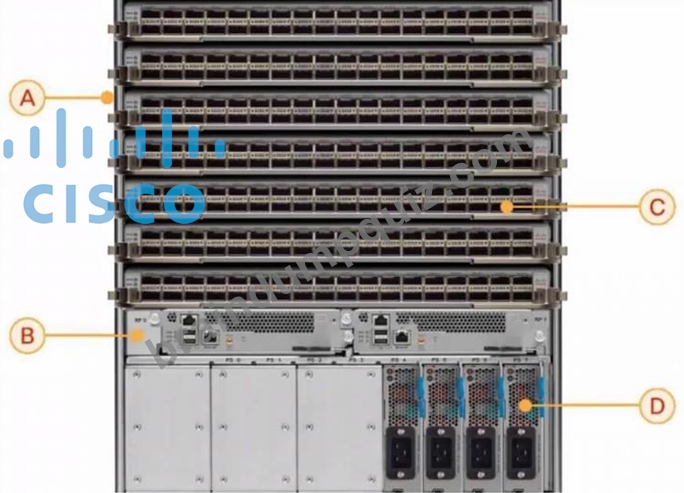
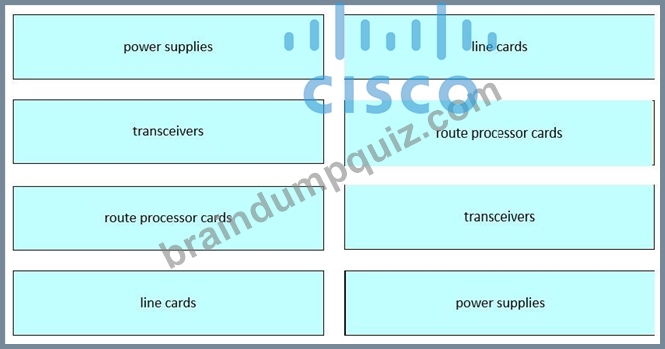
Refer to the exhibit. Drag and drop the names of the field-replaceable units from the left onto the corresponding letters on the image of the Cisco NCS 5500 Series modular router.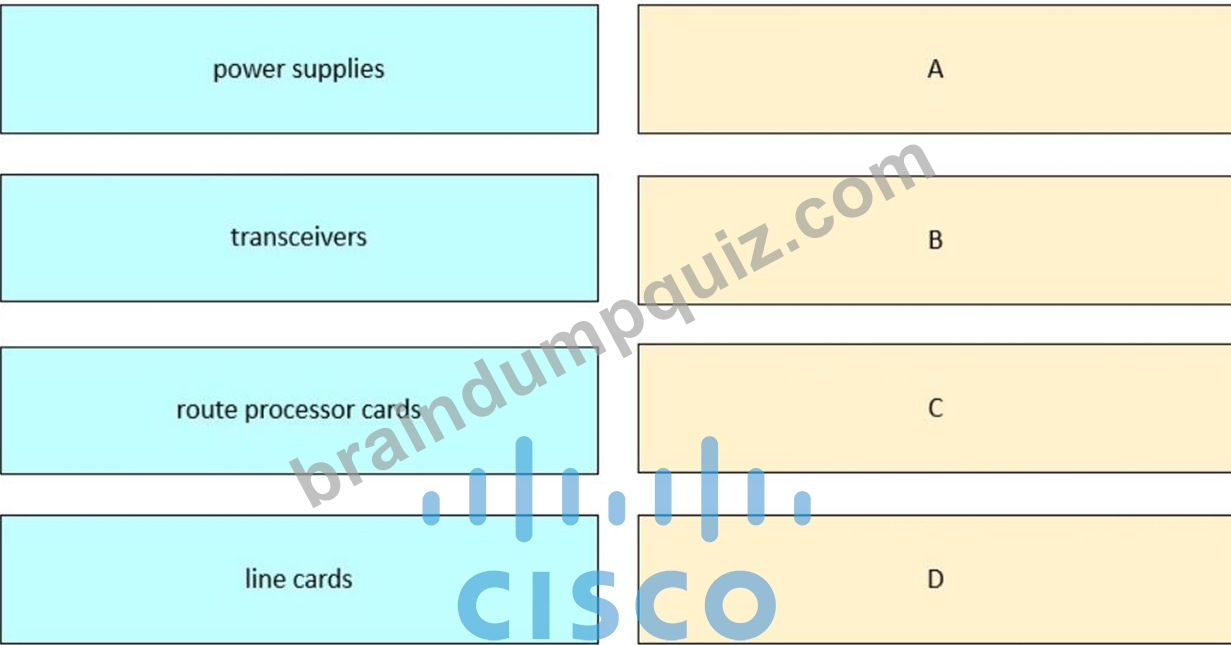
Answer:
Explanation: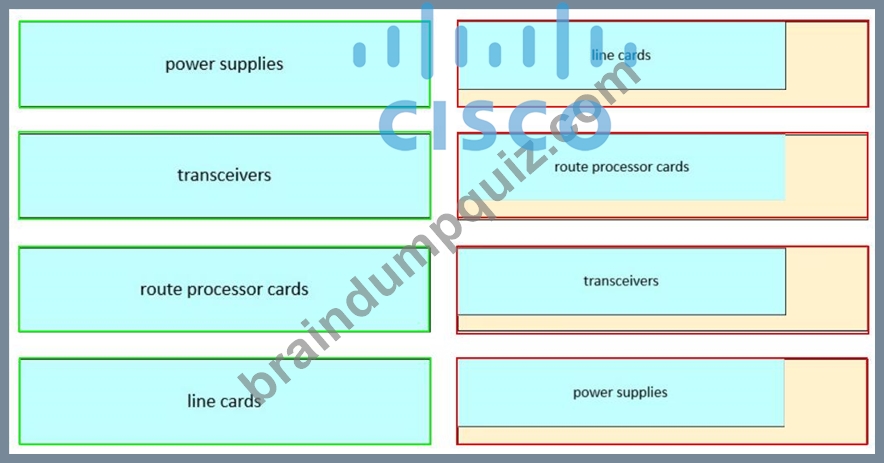
NEW QUESTION # 60
Which two settings are standard Cisco console connections when configuring a terminal emulator to connect to the console port of a Cisco switch? (Choose two.)
- A. Speed (baud rate): 9600
- B. Stop bits: 2
- C. Data bits: 8
- D. Flow control: Hardware
- E. Parity: Even
Answer: A,C
Explanation:
When configuring a terminal emulator (such as PuTTY, Tera Term, or HyperTerminal) to connect to the console port of a Cisco switch, the standard settings are as follows:
Speed (baud rate): 9600
This is the default transmission speed for Cisco console ports, ensuring compatibility across various devices.
Data bits: 8
This setting specifies that each character transmitted consists of 8 data bits, which is standard for most serial communications.
Parity: None
No parity bit is used, meaning there is no additional error-checking bit appended to each character.
Stop bits: 1
One stop bit indicates the end of a character transmission.
Flow control: None
No flow control is employed, allowing continuous data transmission without hardware or software-based pausing.
Therefore, options C (Speed: 9600) and D (Data bits: 8) are correct. Options A (Stop bits: 2), B (Flow control: Hardware), and E (Parity: Even) deviate from the standard settings and may result in communication issues if configured.
NEW QUESTION # 61
Which layer of the OSI model provides error detection and defines how access to the media is controlled?
- A. Physical layer
- B. Presentation layer
- C. Data link layer
- D. Network layer
Answer: C
Explanation:
The Data Link Layer (Layer 2) of the OSI model is responsible for node-to-node data transfer and plays a crucial role in error detection and media access control. It ensures that data frames are transmitted to the correct device on a local network segment.
This layer is divided into two sublayers:
* Logical Link Control (LLC):Manages frame synchronization, flow control, and error checking.
* Media Access Control (MAC):Controls how devices on the network gain access to the medium and permission to transmit data.
Together, these sublayers ensure reliable data transmission by detecting and possibly correcting errors that may occur in the Physical Layer. They also manage how devices share the transmission medium, preventing collisions and ensuring orderly communication.
Reference:Supporting Cisco Devices for Field Technicians (FLDTEC) - Cisco IOS Software Basics
NEW QUESTION # 62
Drag and drop the virtualized data center components from the left onto the corresponding descriptions on the right.
Answer:
Explanation:
Explanation: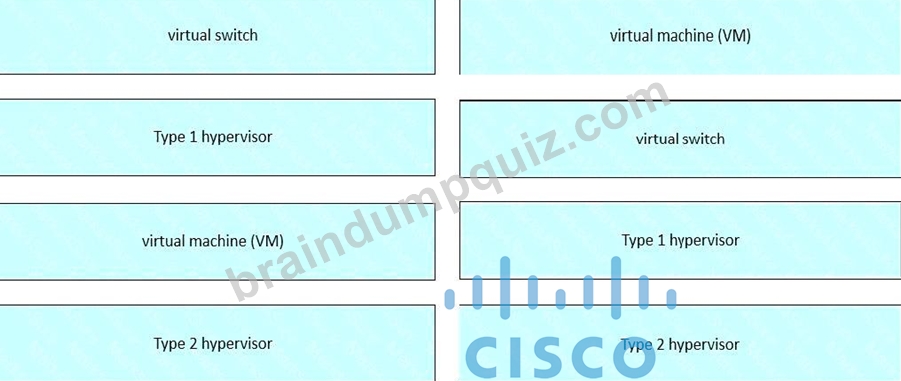
In theFLDTEC curriculum, Cisco emphasizes understanding of virtualized components in enterprise networks and UCS environments:
Virtual Switch- Operates within a hypervisor, replicates L2 behavior for inter-VM and external connectivity.
Type 1 Hypervisor- Also called "bare-metal," examples include VMware ESXi and Microsoft Hyper-V Core; optimized for data center performance.
Virtual Machine (VM)- A logical instance of a system that runs its own OS and apps, powered by virtualized CPU, RAM, and storage.
Type 2 Hypervisor- Runs atop an existing OS (e.g., VMware Workstation, VirtualBox), ideal for labs and dev/testing.
Mastering these definitions supports field technicians inUCS deployments, virtualization troubleshooting, and remote infrastructure diagnostics.
NEW QUESTION # 63
What is the primary reason for placing heavier devices toward the bottom of the rack when installing replacement hardware?
- A. To facilitate easier cable management
- B. To simplify device maintenance
- C. To improve air circulation
- D. To maintain rack stability
Answer: D
Explanation:
Theprimary reasonfor placing heavier equipment, such as UPS units or core switches, at thebottom of a rack is tomaintain stability. A lower center of gravity reduces the risk of tipping, especially when the rack is not yet bolted or braced.
This is a standard safety precaution in network hardware installation and is particularly important when racks are being serviced or relocated.
Reference:Supporting Cisco Devices for Field Technicians (FLDTEC) - Safety and ESD Precautions Explanation:
The primary reason for placing heavier devices toward the bottom of the rack is to maintain rack stability.
This helps ensure the rack remains balanced and prevents tipping, especially when multiple devices are installed.
NEW QUESTION # 64
Which command is used to download a copied configuration file from a TFTP server to merge it with the running configuration of a replacement Cisco device?
- A. load tftp: running-config
- B. merge tftp: running-config
- C. copy tftp: startup-config
- D. copy tftp: running-config
Answer: D
NEW QUESTION # 65
Which component of the Cisco Room system requires removal of the upper textile grille and the use of release levers during its replacement process?
- A. Codec
- B. Antenna module
- C. Quad camera
- D. Loudspeaker
Answer: C
Explanation:
In Cisco Room systems such as the Room Kit Pro and similar setups, replacing thequad camerainvolves a physical disassembly process. Specifically, theupper textile grille must be removedto gain access to the internal mounting mechanism. After that,release levers are used to disengage the quad camera unitfrom its housing.
This procedure ensures secure installation while allowing relatively straightforward removal when maintenance or replacement is necessary. The codec, loudspeaker, and antenna module do not typically require this specific removal method.
Reference:Supporting Cisco Devices for Field Technicians (FLDTEC) - Maintenance and RMA Procedures
NEW QUESTION # 66
Which deployment scenarios are Cisco 8000 Series routers primarily designed for?
- A. remote branch offices and retail locations
- B. small business and home office networks
- C. service provider and web-scale networks
- D. campus LAN access and distribution layers
Answer: C
Explanation:
Cisco 8000Series routers are primarily designed for service provider and web-scale networks, offering high- performance routing capabilities to handle large-scale, high-bandwidth environments typically found in service provider infrastructures and data centers.
The Cisco 8000 Series routers are part of Cisco's high-performance routing portfolio. As documented in the official Cisco product and FLDTEC study materials:
Cisco 8000 Series routers are purpose-built for service provider and cloud-scale datacenters.
They are designed to support massive bandwidth, 5G core, and edge routing demands.
These routers provide scalable, high-performance architecture, using Cisco Silicon One ASICs, enabling terabits of throughput with advanced telemetry and network programmability.
Why the other options are incorrect:
A:Remote branches and retail typically use ISR/ASR 1000/1100 Series.
C:Home or small business networks use Cisco RV Series or Meraki MX Series.
D:LAN access/distribution layers in campuses commonly use Catalyst 9000 Series switches or ISR routers, not high-end core routers.
The 8000 Series is typically found in service provider core, data center interconnect, and hyperscale cloud deployments (e.g., Google, Meta, AWS).
NEW QUESTION # 67
Which two actions ensure a smooth transition to the new hardware when replacing a Cisco UCS C-Series Rack-Mount Server? (Choose two.)
- A. Reconfigure the DHCP server to assign a new IP address to the replacement server.
- B. Decommission the server if it is integrated in a Cisco UCS domain.
- C. Update the firmware on the fabric interconnects.
- D. Back up the server configuration using Cisco Integrated Management Controller.
- E. Temporarily disable all firewalls during the replacement process.
Answer: B,D
Explanation:
To ensure a smooth replacement of a Cisco UCS C-Series Rack-Mount Server, two critical actions are:
Back up the server configuration using the Cisco Integrated Management Controller (CIMC): This preserves all configuration data such as BIOS settings, RAID setup, and network configuration. After replacing the hardware, this configuration can be restored to minimize setup time.
Decommission the server if it is integrated in a Cisco UCS domain: Before physically replacing the server, decommissioning it ensures the UCS Manager properly releases it from the inventory, preventing configuration conflicts or orphaned profiles.
Other options, like reconfiguring DHCP or disabling firewalls, are not required procedures for a UCS C-Series hardware swap.
NEW QUESTION # 68
Refer to the exhibit.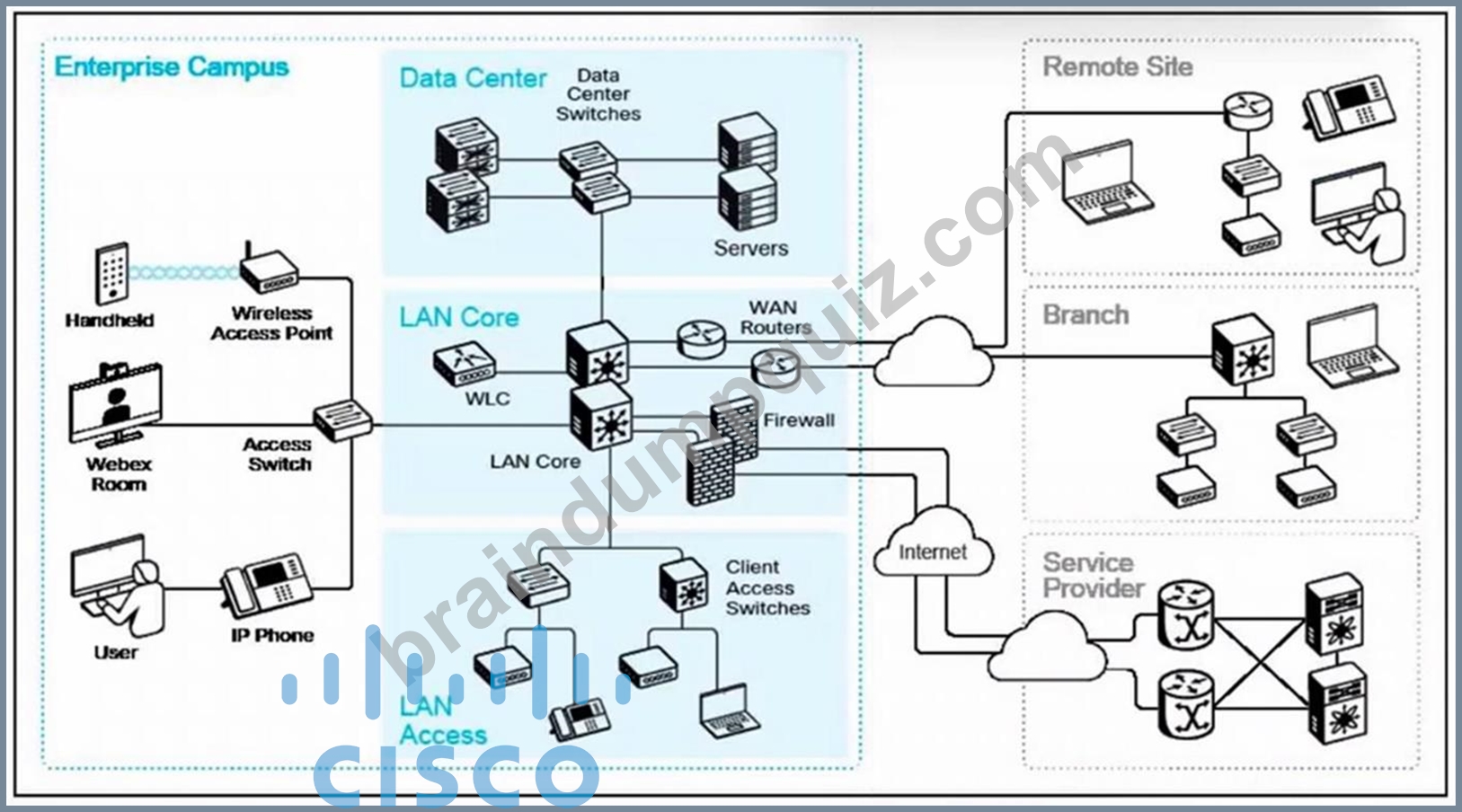
Refer to the exhibit. What are two ways remote sites or branches connect to the enterprise campus network? (Choose two.)
- A. LAN core switches
- B. IPsec VPN tunnels
- C. Ad hoc Wi-Fi network
- D. Access layer switches
- E. WAN links
Answer: B,E
Explanation:
In enterprise networking, remote sites or branch offices connect to the central campus network using:
WAN Links: These are dedicated communication paths that connect geographically dispersed networks. WAN links can be leased lines, MPLS circuits, or other forms of long-distance connectivity that facilitate reliable data transmission between remote sites and the main campus.
IPsec VPN Tunnels: Internet Protocol Security (IPsec) VPNs provide secure, encrypted tunnels over the public internet, allowing remote sites to connect to the enterprise network securely. This method is cost-effective and widely used for connecting branch offices to the central network infrastructure.
Access layer switches (Option A) and LAN core switches (Option E) are components within a local network and do not facilitate remote connectivity. Ad hoc Wi-Fi networks (Option D) are temporary and lack the security and reliability required for enterprise-level remote connections.
NEW QUESTION # 69
......
Exam Valid Dumps with Instant Download Free Updates: https://interfacett.braindumpquiz.com/800-150-exam-material.html