

Free CIFC Exam Braindumps certification guide Q&A
CIFC Certification Overview Latest CIFC PDF Dumps
IFSE Institute CIFC Exam Syllabus Topics:
| Topic | Details |
|---|---|
| Topic 1 |
|
| Topic 2 |
|
| Topic 3 |
|
| Topic 4 |
|
| Topic 5 |
|
| Topic 6 |
|
| Topic 7 |
|
| Topic 8 |
|
NEW QUESTION # 115
Jabir begins the registration process with his new dealer Prosper Wealth Inc. Jabir is excited about his new career and eager to start calling clients, opening new accounts, and selling investments. Which of the following CORRECTLY describes when Jabir will be eligible to open new client accounts and sell investments?
- A. Upon formal confirmation from the regulator
- B. Upon registration application by the dealer
- C. Upon passing the proficiency course
- D. Upon employment with the dealer
Answer: A
NEW QUESTION # 116
Your client, Rinaldo, wants to know more about the fees associated with his mutual funds. What can you tell him about a mutual fund's management expense ratio (MER)?
- A. Mutual funds are required to calculate the MER on a daily basis.
- B. Mutual fund performance is not impacted by the MER since rates of return are published net of fees.
- C. The MER reflects the percentage of each dollar of fund assets that is used to pay for management services.
- D. Trailer and brokerage fees are charged separately from the MER.
Answer: C
Explanation:
Explanation
C is correct because the management expense ratio (MER) reflects the percentage of each dollar of fund assets that is used to pay for management services and operating expenses of a mutual fund. The MER includes various fees and expenses, such as management fees, administration fees, trailer fees, audit fees, legal fees, and taxes. The MER reduces the return of the fund, as it is deducted from the fund's income and capital gains before they are distributed to investors. Mutual funds are not required to calculate the MER on a daily basis (A), but rather on an annual basis. Trailer and brokerage fees are included in the MER (B), not charged separately. Mutual fund performance is impacted by the MER (D), as it lowers the net return of the fund. Rates of return are published net of fees, but they do not reflect the impact of the MER on the fund's performance.
References: Canadian Investment Funds Course (CIFC) | IFSE Institute
NEW QUESTION # 117
Sean purchases 500 units of Penn Canadian Equity Fund when the net asset value per unit (NAVPU) is
$16.70. On December 15, the mutual fund's NAVPU is $21. On December 16, the mutual fund declares a distribution of $1.25 per unit. Sean's distribution is immediately reinvested and he purchases additional units of the mutual fund.
Which of the following statements about the effect of the distribution is correct?
- A. The total value of Sean's mutual fund holdings after the distribution and reinvestment is §9,875.
- B. The NAVPU of the mutual fund does not change after the distribution since Sean reinvests his distribution and purchases additional units.
- C. Sean's distribution is reinvested at a NAVPU of $19.75 and he receives approximately 31.65 additional units.
- D. After the distribution. Sean will have J&625 in cash and JB8.350 worth of the Penn Canadian Equity Fund.
Answer: C
Explanation:
Explanation
Sean's distribution is reinvested at a NAVPU of $19.75 and he receives approximately 31.65 additional units.
When a mutual fund declares a distribution, it reduces its NAVPU by the amount of the distribution per unit.
In this case, the NAVPU drops from $21 to $19.75 after the distribution of $1.25 per unit. Sean's distribution is $625 ($1.25 x 500 units), which he reinvests in the mutual fund at the new NAVPU of $19.75. He receives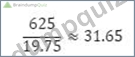
additional units. The total value of Sean's mutual fund holdings after the distribution and reinvestment is (500+31.65)×19.75=$10,500
, not $9,875. The NAVPU of the mutual fund does change after the distribution, regardless of whether Sean reinvests his distribution or not. References: [Unit 7: Mutual Funds Administration]
NEW QUESTION # 118
At 4:00 p.m. Eastern Time on July 6, the following information is collected for the Marigold Canadian Dividend Fund: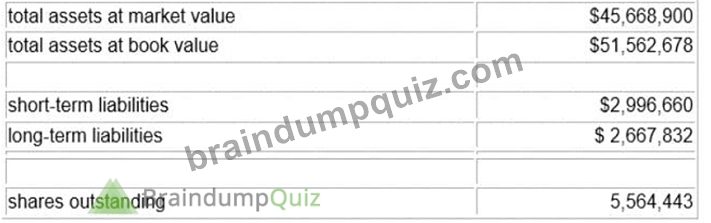
What is the net asset value per unit NAVPU for the Marigold Canadian Dividend Fund for July 6?
- A. $7.65
- B. $8.25
- C. $9.27
- D. $7.19
Answer: B
Explanation:
Explanation
This is the net asset value per unit (NAVPU) for the Marigold Canadian Dividend Fund for July 6. The NAVPU is calculated by dividing the net asset value (NAV) of the fund by the number of units outstanding. In this case, the NAVPU is $8.25 ($45,668,900 / 5,564,443).
The NAV is the value of a fund's assets minus the value of its liabilities. The value of assets is the value of all the securities in the portfolio, plus any cash and cash equivalents, plus any accrued income for the day. The value of liabilities is the value of all short-term and long-term liabilities, plus any accrued expenses for the day. The NAV is usually expressed on a per-share or per-unit basis, which is the NAVPU.
The NAVPU is the price at which investors can buy or sell units of the fund. It is determined at the end of each trading day based on the closing market prices of the portfolio's securities. The NAVPU can change daily depending on the performance of the securities in the fund and the fund's expenses.
NEW QUESTION # 119
Terri, 30 years old, is the marketing manager at Provincial Winery with an average annual income of $60,000.
Her spouse Yvette, 28 years old, is a project manager with a telecommunications firm earning
$70,000 per year. You are helping them to organize their investments and are trying to assess their financial resources.
Which of the following is the best question to ask?
- A. What is your investment experience?
- B. Do you have any children?
- C. Do you have pension plans at work?
- D. When do you need the money?
Answer: C
Explanation:
Explanation
One of the steps in the Know Your Client (KYC) rule is to assess the client's financial resources, which include their income, assets, liabilities, and net worth. Asking about pension plans at work is a relevant question to determine the client's sources of income and potential retirement savings. Pension plans can also affect the client's risk tolerance and investment objectives, as they may provide a stable and guaranteed income in the future. Asking about children, money needs, and investment experience are also important questions, but they relate to other aspects of the KYC rule, such as personal circumstances, time horizon, and investment knowledge. References:
* Canadian Investment Funds Course (CIFC) Study Guide, Chapter 1: The Investment Funds Industry, Section 1.4: The Know Your Client (KYC) Rule, page 1-111
* Know Your Client (KYC) Definition - Investopedia
NEW QUESTION # 120
David had $10,000 in his investment account with Dynamic Investments, a mutual funds dealer. On June 28, David wants to buy 500 units in ABC Canadian Dividend Fund that has a Net Asset Value Per Unit (NAVPU) of $14.10. His friend Robert suggests that he may get a better price if he used the strategy of dollar-cost averaging. David then instructs his Dealing Representative to place a purchase order for 100 units on the first of every month starting July 1st for the next 5 months.
The orders are executed at the following NAVPUs.
July 01, $14.00
Aug. 01, $14.50
Sep. 01, $15.00
Oct. 01, $14.25
Nov. 01, $16.50
Did David get a better purchase price following the dollar-cost averaging strategy compared to making a lump-sum purchase of 500 shares on Jun 28, 20xx?
- A. David got his 500 units at a higher price than the lump sum price he would have paid
- B. David realizes that Dollar cost averaging is the best strategy for getting lower prices.
- C. David got his 500 units at a lower price than the lump sum price he would have paid.
- D. David got his 500 units at the same price as the lump sum price he would have paid.
Answer: A
NEW QUESTION # 121
Saheed is a retiree who is considering splitting his pension income with his wife, Minu.
Which of the following outcomes may occur if he shares his pension benefits?
- A. Minu will be exposed to a pension adjustment (PA) if she receives income from his pension.
- B. Regardless of how much income each person reports, the total amount of income taxes will not change.
- C. This is a form of tax evasion and is therefore considered illegal based on income tax legislation.
- D. Whether the couple saves on income tax will be dependent on Minu's marginal tax rate.
Answer: D
Explanation:
Explanation
Whether the couple saves on income tax will be dependent on Minu's marginal tax rate. Pension income splitting is a tax planning strategy that allows a spouse or common-law partner who receives eligible pension income to allocate up to 50% of that income to their spouse or common-law partner1. This may result in tax savings if the transferring spouse or common-law partner is in a higher tax bracket than the receiving spouse or common-law partner1. The tax savings depend on the difference between the marginal tax rates of the spouses or common-law partners1. The other statements are incorrect. Minu will not be exposed to a pension adjustment (PA) if she receives income from Saheed's pension. A PA is a measure of the value of benefits accrued in a registered pension plan or deferred profit sharing plan during a calendar year2. It reduces the RRSP contribution room of the plan member, not the spouse or common-law partner who receives part of their pension income2. Pension income splitting is not a form of tax evasion and is not illegal based on income tax legislation. It is a legitimate way to reduce taxable income and taxes payable by shifting income from a higher-income spouse or common-law partner to a lower-income spouse or common-law partner1. Pension income splitting may change the total amount of income taxes paid by the couple, depending on their marginal tax rates. If the transferring spouse or common-law partner is in a higher tax bracket than the receiving spouse or common-law partner, pension income splitting may lower their combined taxes payable1. However, if they are in the same tax bracket, pension income splitting may not have any effect on their taxes payable1.
References: Pension income splitting, Pension adjustment
NEW QUESTION # 122
Nelson is a Dealing Representative with True Wealth Advisors Inc., a mutual fund dealer. Nelson follows proper procedures related to his firm's Relationship Disclosure Information (RDI). Which of the following CORRECTLY describes how Nelson is permitted to evidence that he satisfied his RDI obligation?
- A. Nelson can formalize his relationship under the RDI using a Letter of Engagement that specifies duties, responsibilities, and level of service.
- B. Nelson may retain a copy of the RDI in the client file with detailed notes to confirm that he provided and explained the RDI to the client.
- C. Nelson can record detailed notes which confirm that he provided and explained the Fund Facts to the client within 2 days of the RDI.
- D. Nelson may deliver the RDI to clients who request it and keep detailed notes of the clients who were provided with the RDI.
Answer: B
NEW QUESTION # 123
Manuel is a Dealing Representative for Commonwealth Financial Inc., a mutual fund dealer. His dealer represents many different mutual fund families available, including their own: CF Group of Funds. He is considering recommending a CF equity fund to one of his clients, Stefania. While describing details about the fund, he informs her that accounts are set-up in nominee name, and that their mutual funds are not transferable.
In addition, the fund does pay trailer fees.
What type of information has Manuel described about his potential investment recommendation?
- A. Excessive trading
- B. The material conflict of interest
- C. A Letter of Engagement
- D. Features of a locked-in plan
Answer: B
Explanation:
Explanation
A material conflict of interest is a situation where a dealing representative or a mutual fund dealer has an interest that may affect their ability to act in the best interest of their clients, or that may influence their judgment or behaviour. A material conflict of interest may arise from various sources, such as compensation arrangements, personal or business relationships, or ownership interests. In this case, Manuel has described some information that may indicate a material conflict of interest, such as:
*His dealer represents many different mutual fund families, including their own: CF Group of Funds. This may create a bias or incentive for Manuel to recommend the CF equity fund over other funds that may be more suitable for his client, Stefania.
*The accounts are set-up in nominee name, which means that the dealer is the registered owner of the mutual funds and holds them in trust for the client. This may affect the client's rights and benefits as the beneficial owner of the funds, such as voting rights, transferability, or access to information.
*The mutual funds are not transferable, which means that the client cannot move them to another dealer or fund family without selling them and incurring fees or taxes. This may limit the client's flexibility and choice, and create a lock-in effect for the dealer.
*The fund does pay trailer fees, which are ongoing commissions paid by the fund manager to the dealer for the services and advice provided to the client. This may create a conflict of interest for Manuel, as he may receive a portion of the trailer fees as part of his compensation. This may influence his recommendation of the fund, as he may benefit from the client's continued investment in the fund.
Manuel should disclose these potential material conflicts of interest to his client, Stefania, and explain how they may affect his recommendation of the CF equity fund. He should also ensure that his recommendation is based on the client's needs, objectives, risk tolerance, and time horizon, and that he provides the client with the necessary information and documents, such as the fund facts, to make an informed decision.
References = Canadian Investment Funds Course, Unit 7: The Regulatory Environment, Lesson 1: The Regulatory Framework, Section 7.1.3: Material Conflicts of Interest1; CIFC prepkit, Chapter 7: The Regulatory Environment, Question 7.1.3 2
NEW QUESTION # 124
Wilma has always used the services of a tax preparation firm to file her taxes but is skeptical that she has really benefitted. This year she plans to file her own taxes for the first time.
What would be useful for her to know?
- A. Wilma's tax deductions permit her to reduce her tax payable dollar-for-dollar.
- B. Wilma's non-refundable tax credits may only reduce her taxable income dollar-for-dollar.
- C. Wilma's marginal tax rate may be lowered when tax deductions are applied to her total income.
- D. Wilma's top marginal tax rate will be applied to every taxable dollar when her tax return is filed.
Answer: C
Explanation:
Explanation
Tax deductions are amounts that reduce your total income before calculating your tax payable. They lower your marginal tax rate, which is the tax rate that applies to your last dollar of income. For example, if Wilma's total income is $50,000 and she claims $5,000 in tax deductions, her taxable income will be $45,000 and her marginal tax rate will be lower than if she had no deductions. Therefore, A is the correct answer.
References: All deductions, credits, and expenses - Personal income tax - Canada.ca
NEW QUESTION # 125
Which of the following statements about registered education savings plans (RESPs) is CORRECT?
- A. Contributions to RESPs are tax deductible.
- B. There is a yearly contribution limit per beneficiary.
- C. RESPs must be collapsed by the end of the 31st year of its starting date
- D. Contributed funds grow tax-free within the plan.
Answer: D
NEW QUESTION # 126
Every February, Reginald, a Dealing Representative, feels pressured by his Manager to generate new registered retirement savings plans (RRSP) and contributions to assist the branch in meeting broader business targets. Reginald is nearing the end of February, and he has a meeting with a new client, Orel. Orel wants to open a tax-free savings account (TFSA) to develop emergency savings because he does not want to worry about his withdrawals being taxed. Reginald suggests that if Orel were to contribute to an RRSP first, then the resulting tax savings could be used to fund a new emergency account.
In relation to account suitability, what can be said about Reginald's advice?
- A. By convincing Orel to contribute an RRSP, instead of a TFSA, Reginald has put his client's interest first.
- B. Recommending an investment solution that addresses two needs is putting Reginald's client's interest first
- C. Reginald is putting the client's interest first by informing Orel why he should change his purpose for investing.
- D. Based on Orel's stated need, recommending an RRSP contribution is unsuitable.
Answer: D
Explanation:
Explanation
Based on Orel's stated need, recommending an RRSP contribution is unsuitable because RRSP withdrawals are taxed as income and may affect Orel's eligibility for government benefits. A TFSA is more suitable for Orel's goal of developing emergency savings because TFSA withdrawals are tax-free and do not affect income-tested benefits. References: Investment Funds in Canada (IFC) | Canadian Securities Institute
NEW QUESTION # 127
Frederic recently sold his units in a US dollar (USD) denominated mutual fund. He wants to convert the proceeds back to Canadian dollars (CAD). If he received proceeds of $1,200 USD from the sale and the exchange rate is $1 CAD for $0.99 USD, how much will Frederic receive in Canadian dollars?
- A. $1-188.00
- B. $1,200.00
- C. $1, 12.12
- D. $1,320.00
Answer: C
Explanation:
Explanation
To convert the proceeds from USD to CAD, Frederic needs to divide the amount in USD by the exchange rate.
The exchange rate is $1 CAD for $0.99 USD, which means that $0.99 USD is equivalent to $1 CAD.
Therefore, Frederic will receive
CAD in Canadian dollars. References: Canadian Investment Funds Course (CIFC) | IFSE Institute, Unit 8, Lesson 2
NEW QUESTION # 128
Faruq is a Dealing Representative with Smart Planning Group, a mutual fund dealer. Faruq meets with his new client, Taline, and learns that she lives on a low, fixed income.
Taline tells Faruq that she wants to maximize her investment returns as high as possible to make up the difference. Taline also indicates that she cannot afford large investment losses because her income is low.
Which of the following CORRECTLY describes how Faruq should assess Taline's risk profile?
- A. Taline's risk profile should be "low" because her risk capacity is low and she cannot afford lame investment losses.
- B. Faruq should override the risk that Taline is able to accept because her return expectations cannot otherwise be met.
- C. Faruq should assess Taline's risk profile based on the higher of her: (1) risk tolerance and (2) risk capacity
- D. Taline's risk profile should be "high"" because she is willing to accept risk in order to maximize her investment returns.
Answer: A
Explanation:
Explanation
Taline's risk profile should be "low" because her risk capacity is low and she cannot afford large investment losses. Risk capacity is the degree of risk that an investor must take in order to achieve their financial goals, while risk tolerance is the degree of risk that an investor is willing to take. Risk capacity is more important than risk tolerance in determining an investor's risk profile1. Taline has a low risk capacity because she lives on a low, fixed income and cannot afford to lose money. Her risk tolerance may be high, but that does not mean she should take more risk than she can handle. Faruq should not override Taline's risk capacity or assess her risk profile based on the higher of her risk tolerance and risk capacity, as that would be unsuitable and unethical. References: Unit 3: Suitability
NEW QUESTION # 129
When you buy a put option, which of the following is TRUE?
- A. You have the right to purchase a set number of shares at a set price.
- B. You have the right to sell a set number of shares at a set price.
- C. You have the obligation to sell a set number of shares at a set price.
- D. You have the obligation to buy a set number of shares at a set price.
Answer: B
NEW QUESTION # 130
Which document contains information regarding the Independent Review Committee compensation?
- A. Fund Facts
- B. Management Reports of Fund Performance
- C. Annual Information Form
- D. Simplified Prospectus
Answer: C
Explanation:
Explanation
The Annual Information Form (AIF) is a document that provides detailed information about a mutual fund, such as its history, structure, management, fees, expenses, risks, policies, and performance. The AIF also contains information regarding the Independent Review Committee (IRC) compensation, which is the amount of fees and expenses paid by the fund to the IRC members for their services. The IRC is a committee of independent individuals who oversee the fund manager's decisions on conflict of interest matters and act in the best interests of the fund and its investors12 References = web search results from search_web(query="Independent Review Committee compensation")12 and Canadian Investment Funds Course (CIFC) - Module 2: Investment Products - Section 2.2: Mutual Funds3
3: https://www.ifse.ca/wp-content/uploads/2021/08/CIFC-Module-2.pdf
NEW QUESTION # 131
Sven owns preferred shares that give him the option to sell his holdings back to the issuing company at a predetermined price and within a specified time. What type of preferred shares does Sven own?
- A. convertible
- B. participating
- C. redeemable
- D. retractable
Answer: D
Explanation:
Explanation
A is correct because retractable preferred shares are a type of preferred shares that give the holder the option to sell the shares back to the issuer at a predetermined price and within a specified time. This feature provides the holder with more flexibility and protection against interest rate fluctuations. Participating preferred shares (B) are a type of preferred shares that give the holder the right to receive additional dividends if the issuer's earnings exceed a certain level. Convertible preferred shares are a type of preferred shares that give the holder the option to convert the shares into common shares of the issuer at a predetermined ratio and price.
Redeemable preferred shares (D) are a type of preferred shares that give the issuer the option to buy back the shares from the holder at a predetermined price and within a specified time. References: Canadian Investment Funds Course (CIFC) | IFSE Institute
NEW QUESTION # 132
The owners of Underground Airways Ltd. want to take their privately owned corporation public through an initial public offering (IPO). They are speaking to a specialist from an investment dealer to determine whether it would be advisable to become listed on a stock exchange or the over-the-counter (OTC) market.
In comparing the two options, which of the following considerations is TRUE?
- A. Underground would still be directly involved in the trading of their shares on either market.
- B. If Underground chose to list on the OTC market, there would be no secondary market available for investors.
- C. A stock exchange listing would provide Underground with greater market exposure and public confidence than listing on the OTC market.
- D. Underground would be subject to less stringent listing requirements if they chose the stock exchange as compared to the OTC market.
Answer: C
Explanation:
Explanation
According to the Canadian Investment Funds Course, a stock exchange is a centralized and regulated market where securities of listed companies are traded between buyers and sellers. A stock exchange has strict listing requirements that companies must meet in order to be eligible for trading on the exchange. These requirements may include minimum capitalization, number of shareholders, financial reporting, corporate governance, and compliance with securities laws. A stock exchange also provides liquidity, transparency, and efficiency for the trading of securities.
An over-the-counter (OTC) market is a decentralized and unregulated market where securities that are not listed on a stock exchange are traded between dealers and brokers. An OTC market has no physical location, rather the trading is done through phone, email, or computer networks. An OTC market has lower listing requirements than a stock exchange, which makes it easier for smaller or newer companies to access capital.
However, an OTC market also has less liquidity, transparency, and efficiency than a stock exchange.
Therefore, if Underground Airways Ltd. wants to take their privately owned corporation public through an initial public offering (IPO), they would have to weigh the pros and cons of listing on a stock exchange or the OTC market. One of the main considerations is that a stock exchange listing would provide them with greater market exposure and public confidence than listing on the OTC market. This is because a stock exchange listing signals that the company has met the high standards of the exchange and is subject to ongoing regulation and oversight. A stock exchange listing also attracts more investors, analysts, and media attention than an OTC listing. A stock exchange listing may also increase the value and liquidity of the company's shares.
References: 1: Canadian Investment Funds Course - IFSE Institute 2 (Unit 5: Equity Securities)
NEW QUESTION # 133
Natasha currently owns 2 mutual funds: a bond fund and a Canadian equity fund. She would like to use one of them as her registered retirement savings plan (RRSP) contribution for the year. From a tax efficiency perspective, which mutual fund should she contribute?
- A. either since it makes no difference
- B. the bond fund
- C. the equity fund
- D. it depends on her marginal tax rate
Answer: B
Explanation:
Explanation
The bond fund should be contributed to Natasha's RRSP from a tax efficiency perspective, because interest income from bonds is fully taxable at her marginal tax rate outside of an RRSP. By contributing the bond fund to her RRSP, Natasha can defer paying tax on the interest income until she withdraws it from her RRSP in retirement, when she may be in a lower tax bracket. The equity fund should be kept outside of her RRSP, because dividends and capital gains from equities receive preferential tax treatment compared to interest income. Dividends qualify for the dividend tax credit and capital gains are only 50% taxable. Furthermore, equities tend to have higher returns than bonds over the long term, which means that Natasha would have more after-tax income by keeping them outside of her RRSP. References: Registered Retirement Savings Plan (RRSP), Does it pay to invest in an RRSP? Here's the math
NEW QUESTION # 134
Winter is a Dealing Representative with Top Tier Investing, a mutual fund dealer and member of the Mutual Fund Dealers Association of Canada (MFDA). Which of the following statements about Winter's suitability obligation is CORRECT?
Winter is required to make a suitability determination every time:
i) she makes a recommendation to a client
ii) a client's investment returns decline.
iii) she opens a new client account
iv) the markets fluctuate.
- A. i and ii
- B. iii and iv
- C. i and iii
- D. ii and iii
Answer: C
Explanation:
Explanation
According to the MFDA Rules, a Dealing Representative is required to make a suitability determination every time:
The Dealing Representative makes a recommendation to a client;
The Dealing Representative accepts a trade instruction from a client;
The Dealing Representative opens a new account for a client or changes the account type; The Dealing Representative becomes aware of a material change in the client's KYC information; Securities are transferred or re-registered into the client's account; or There has been a change in the Approved Person responsible for the client's account2 A suitability determination is the process of ensuring that any investment action taken for a client is suitable for the client based on their KYC information, such as investment objectives, risk tolerance, time horizon, financial situation, and investment knowledge. A suitability determination also requires putting the client's interests first and disclosing any material factors involved in the investment action2 Therefore, Winter is required to make a suitability determination every time she makes a recommendation to a client (i) or she opens a new client account (iii). She is not required to make a suitability determination every time a client's investment returns decline (ii) or the markets fluctuate (iv), unless these events trigger a material change in the client's KYC information or affect the suitability of the client's portfolio.
References: 1: MSN-0069 | MFDA 2 (Know-Your-Client (KYC) and Suitability)
NEW QUESTION # 135
What trait or characteristic is normally associated with a person who would be designated as a Trusted Contact Person (TCP)?
- A. Often involved with providing care for the client who requires personal assistance.
- B. Has the authority to make financial decisions on behalf of the client.
- C. Can simplify difficult financial concepts for the client.
- D. Normally has a financial interest in the client's account or assets.
Answer: A
Explanation:
Explanation
A Trusted Contact Person (TCP) is someone who the client authorizes their financial advisor to contact in limited circumstances, such as when the client is vulnerable, has a health issue, or cannot be reached. A TCP should be someone who the client trusts and who is mature and can handle difficult conversations about the client's personal situation. Often, a TCP is someone who is involved with providing care for the client who requires personal assistance, such as a family member, a friend, or a caregiver. A TCP does not have a financial interest in the client's account or assets, does not have the authority to make financial decisions on behalf of the client, and does not need to simplify financial concepts for the client
NEW QUESTION # 136
Malik has been saving money for retirement but he is worried about the impact inflation may have on the value of his savings. He wants to purchase a bond that will give him a steady stream of income that is greater than the inflation rate. He has found a bond issued by a major airline with a market price of $9,200, a par value of $10,000, and a coupon rate of 6.75%. What is the current yield of this bond?
- A. 6.25%
- B. 6.75%
- C. 6.21%
- D. 7.34%
Answer: D
Explanation:
Explanation
The current yield of a bond is the annual interest payment divided by the current market price of the bond. The annual interest payment is the coupon rate multiplied by the par value of the bond. In this case, the annual interest payment is:
6.75%*10,000=675
The current market price of the bond is $9,200. Therefore, the current yield is:
9200675*100%=7.34%
The current yield is higher than the coupon rate because the bond is selling at a discount, meaning that its market price is lower than its par value. This implies that the bond is offering a higher return than the prevailing market interest rate. However, the current yield does not take into account the capital gain or loss that will occur when the bond matures or is sold. A more accurate measure of the bond's return is the yield to maturity (YTM), which is the annualized rate of return that accounts for both the interest payments and the price change of the bond over its remaining term.
References:
* Canadian Investment Funds Course (CIFC) Study Guide, Chapter 5: Fixed-Income Securities, Section
5.2: Bond Pricing and Yield, page 5-61
* Current Yield Definition - Investopedia2
NEW QUESTION # 137
Which statement regarding the Fund Facts document is CORRECT?
- A. Before accepting an order from a client, a Dealing Representative is expected to provide and explain the Fund Facts document.
- B. The Fund Facts document must not contain performance data.
- C. For leveraged accounts, the Fund Facts document is not required if the client has been provided with the Leverage Risk Disclosure document.
- D. The Fund Facts document must be delivered to the client, electronically or in writing, within 5 days of the transaction date.
Answer: A
Explanation:
Explanation
The Fund Facts document is a summary disclosure document that highlights key information about a mutual fund or an exchange-traded fund (ETF), such as the performance history, investments, fees, and risks.
According to the Point of Sale (POS) disclosure rules, a Dealing Representative must provide and explain the Fund Facts document to the client before accepting an order to buy or switch a fund. This allows the client to make an informed investment decision and to know their rights.
References = Fund Facts | AMF - Autorite des marches financiers, Fund Facts/ETF Facts - Fidelity, Understanding Fund Facts | GetSmarterAboutMoney.ca, IFSE CIFC Module 2: The Investment Industry, page
2-16.
NEW QUESTION # 138
Sheldon is a 25 year old graphic designer. He has just started working and saves regularly. Apart from his regular salary he also earns extra money from freelancing after office hours and during weekends. His earnings from his freelance work are sufficient for meeting his living expenses. He saves the entire amount of his salary. He has heard about lifecycle funds but has come to you for additional information.
Which of the following statement about lifecycle funds is TRUE?
- A. As Sheldon gets older, the life cycle asset allocation changes from more risky to less risky.
- B. The asset allocation of a lifecycle fund is set based on the age demographic of its unitholders and remains the same for the time frame of the lifecycle fund.
- C. All lifecycle funds start with equal allocations to cash, fixed income and equities before being re-balanced.
- D. Investor income is the only basis for changing the asset allocation of a lifecycle mutual fund.
Answer: A
NEW QUESTION # 139
Pierre wants to discuss the merits of a specific mutual fund with his Dealing Representative, Simone. There are no trailer fees associated with this fund. Simone is familiar with the mutual fund that Pierre is referring to, which is not offered by her dealer. They schedule an appointment to further discuss his investment portfolio.
Which behaviour from Simone is ethical?
- A. When comparing her dealer's own mutual funds to the one Pierre discovered, Simone emphasizes the importance of similar net rates of return and minimizes the significance of management expense ratios (MERs).
- B. Knowing Pierre does not like that her dealer's funds have trailer fees, she chooses not to discuss the relationship between trailer fees and MER while making comparisons.
- C. Simone's ability to keep her knowledge current on competitors' investment offerings shows that she is putting her client's interest first.
- D. While comparing Fund Facts of the different mutual funds, Simone points out that not only are the fund management expenses different but so are the investor profiles for each fund.
Answer: D
NEW QUESTION # 140
......
The Best IFSE Institute CIFC Study Guides and Dumps of 2026: https://interfacett.braindumpquiz.com/CIFC-exam-material.html