

Pass Your AI-102 Dumps as PDF Updated on 2026 With 383 Questions
Microsoft AI-102 Real Exam Questions and Answers FREE
NEW QUESTION # 51
You have an Azure subscription that contains an Azure OpenAI resource named AH.
You build a chatbot that will use AI1 to provide generative answers to specific questions.
You need to ensure that the responses are more creative and less deterministic.
How should you complete the code? To answer, select the appropriate options in the answer area.
NOTE: Each correct selection is worth one point.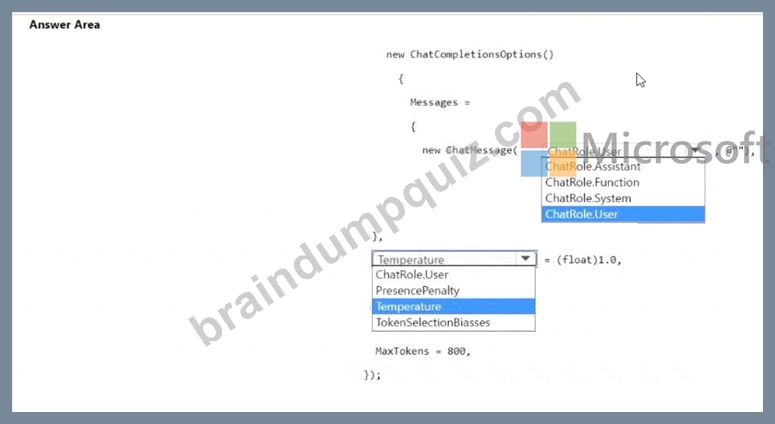
Answer:
Explanation: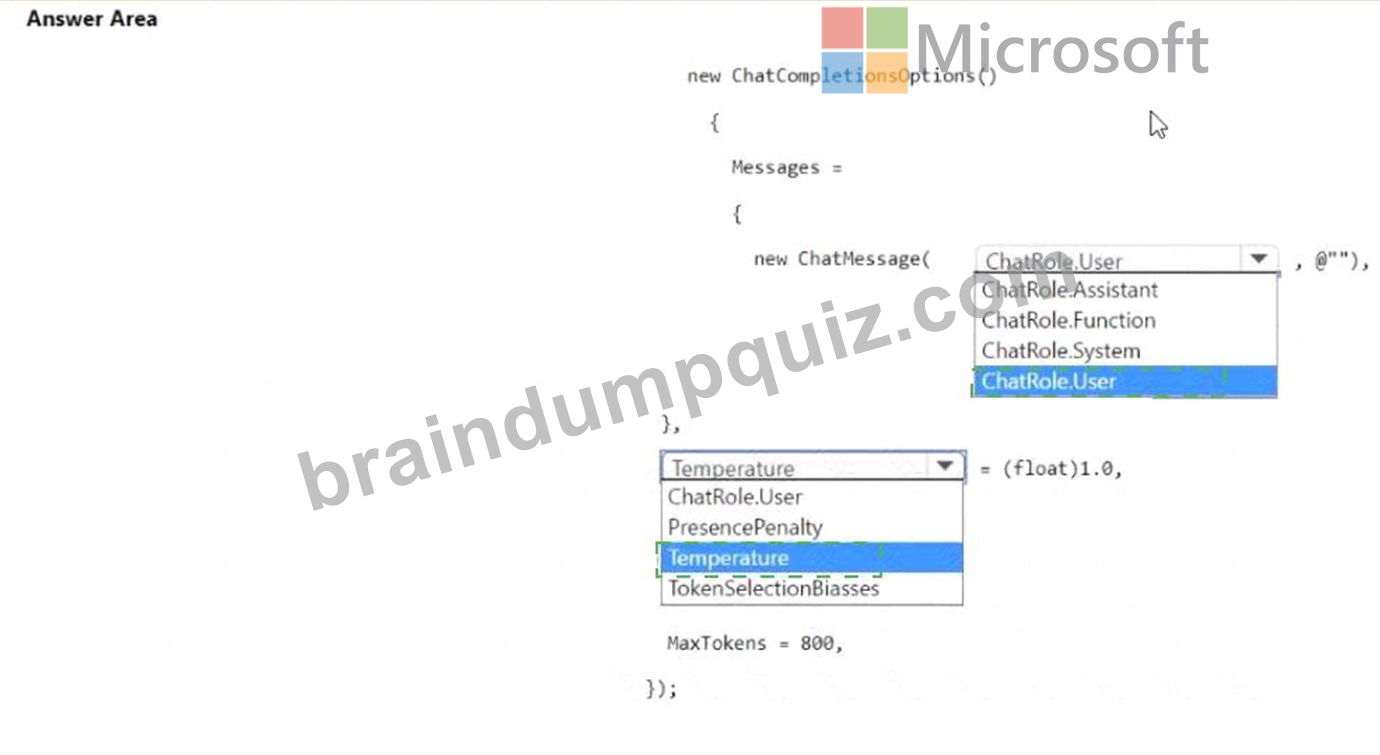
Explanation: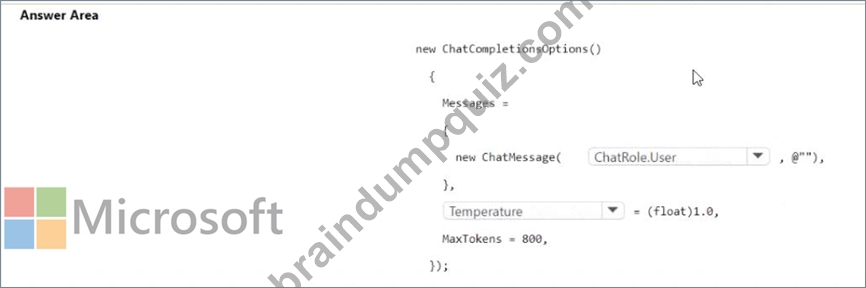
NEW QUESTION # 52
You are developing the smart e-commerce project.
You need to implement autocompletion as part of the Cognitive Search solution.
Which three actions should you perform? Each correct answer presents part of the solution. (Choose three.) NOTE: Each correct selection is worth one point.
- A. Add a suggester that has the three product name fields as source fields.
- B. Make API queries to the search endpoint and include the product name fields in the searchFields query parameter.
- C. Set the analyzer property for the three product name variants.
- D. Add a suggester for each of the three product name fields.
- E. Make API queries to the autocomplete endpoint and include suggesterName in the body.
- F. Set the searchAnalyzer property for the three product name variants.
Answer: A,C,E
Explanation:
Explanation
Scenario: Support autocompletion and autosuggestion based on all product name variants.
A: Call a suggester-enabled query, in the form of a Suggestion request or Autocomplete request, using an API.
API usage is illustrated in the following call to the Autocomplete REST API.
POST /indexes/myxboxgames/docs/autocomplete?search&api-version=2020-06-30
{
"search": "minecraf",
"suggesterName": "sg"
}
B: In Azure Cognitive Search, typeahead or "search-as-you-type" is enabled through a suggester. A suggester provides a list of fields that undergo additional tokenization, generating prefix sequences to support matches on partial terms. For example, a suggester that includes a City field with a value for "Seattle" will have prefix combinations of "sea", "seat", "seatt", and "seattl" to support typeahead.
F: Use the default standard Lucene analyzer ("analyzer": null) or a language analyzer (for example, "analyzer":
"en.Microsoft") on the field.
Reference:
https://docs.microsoft.com/en-us/azure/search/index-add-suggesters
NEW QUESTION # 53
You run the following command.
For each of the following statements, select Yes if the statement is true. Otherwise, select No.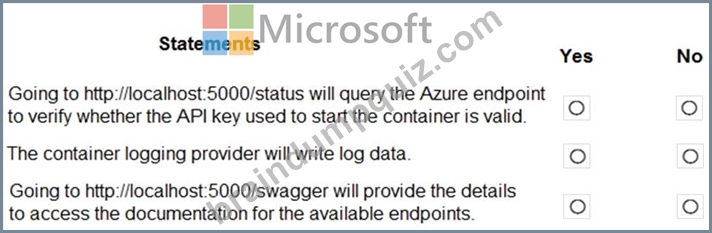
Answer:
Explanation: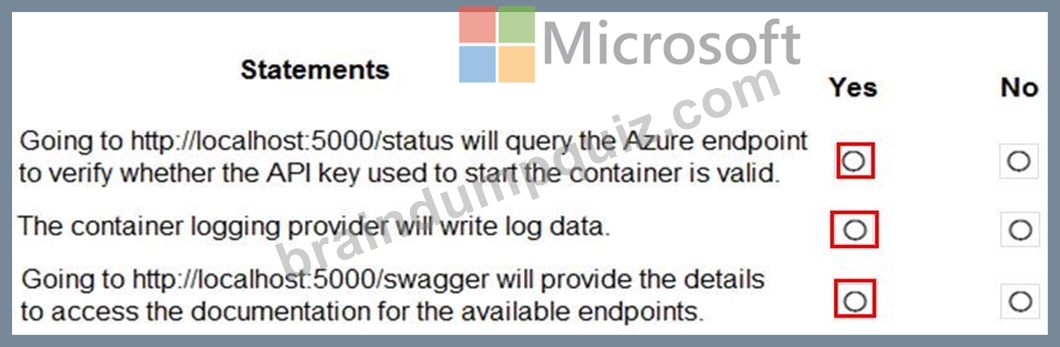
Reference:
https://docs.microsoft.com/en-us/azure/cognitive-services/luis/luis-container-howto
NEW QUESTION # 54
Select the answer that correctly completes the sentence.
Answer:
Explanation:
Explanation:
NEW QUESTION # 55
Hotspot Question
You make an API request and receive the results shown in the following exhibits.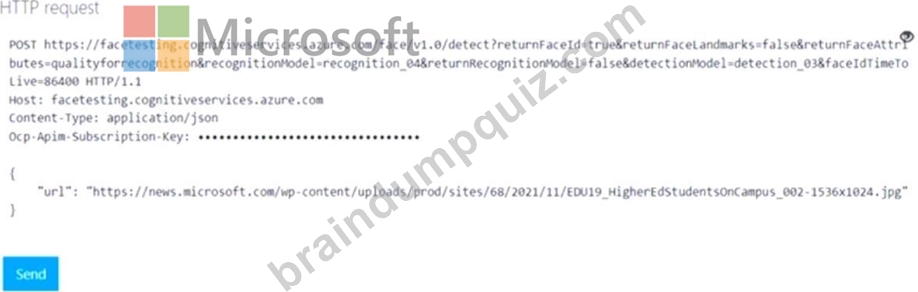
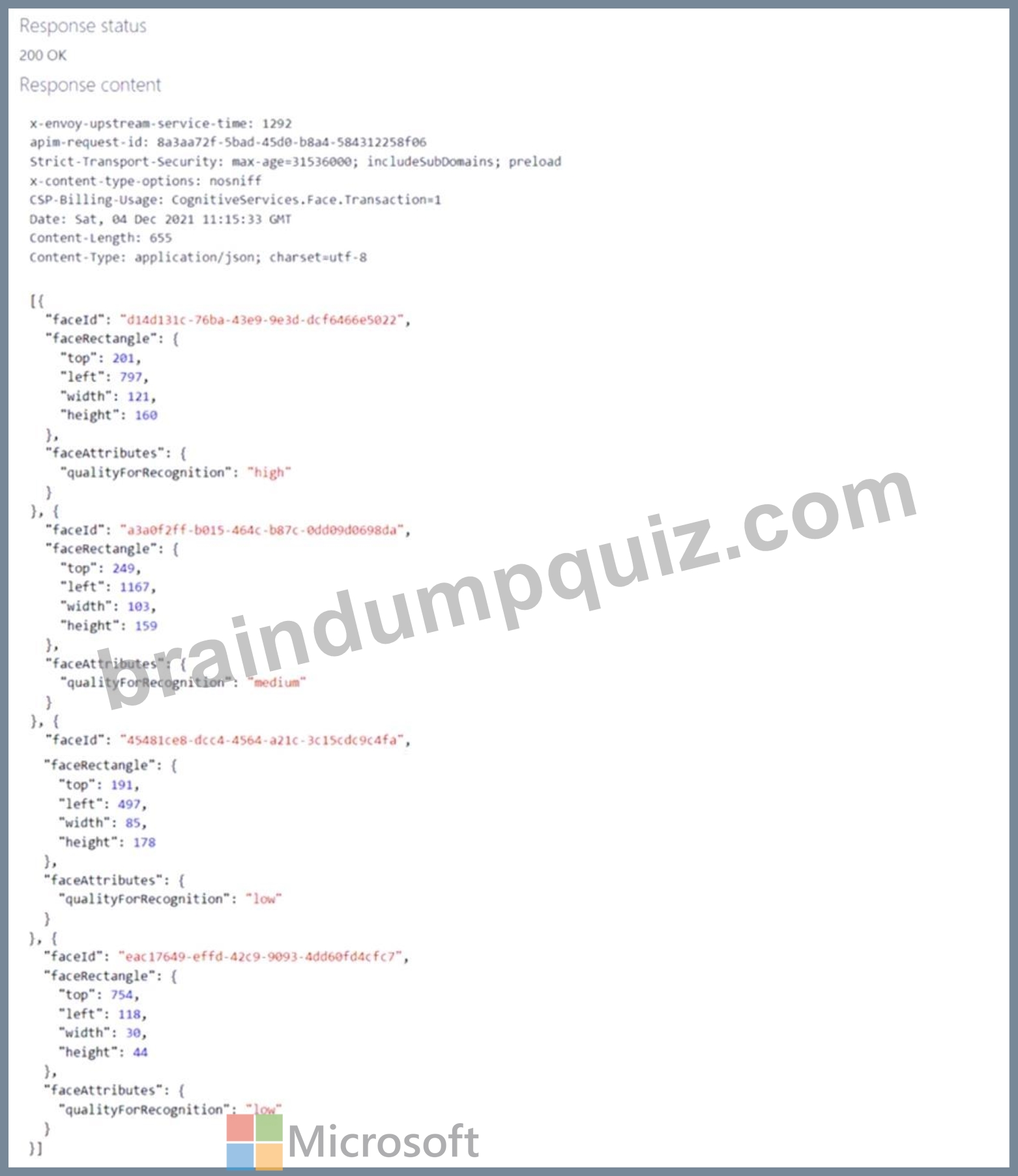
Use the drop-down menus to select the answer choice that completes each statement based on the information presented in the graphic.
NOTE: Each correct selection is worth one point.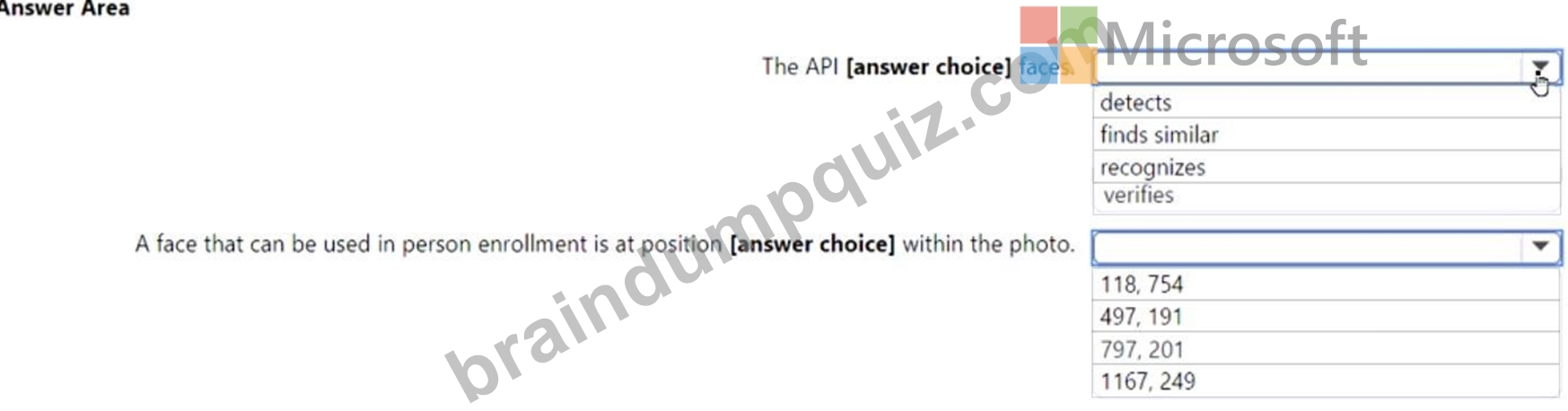
Answer:
Explanation: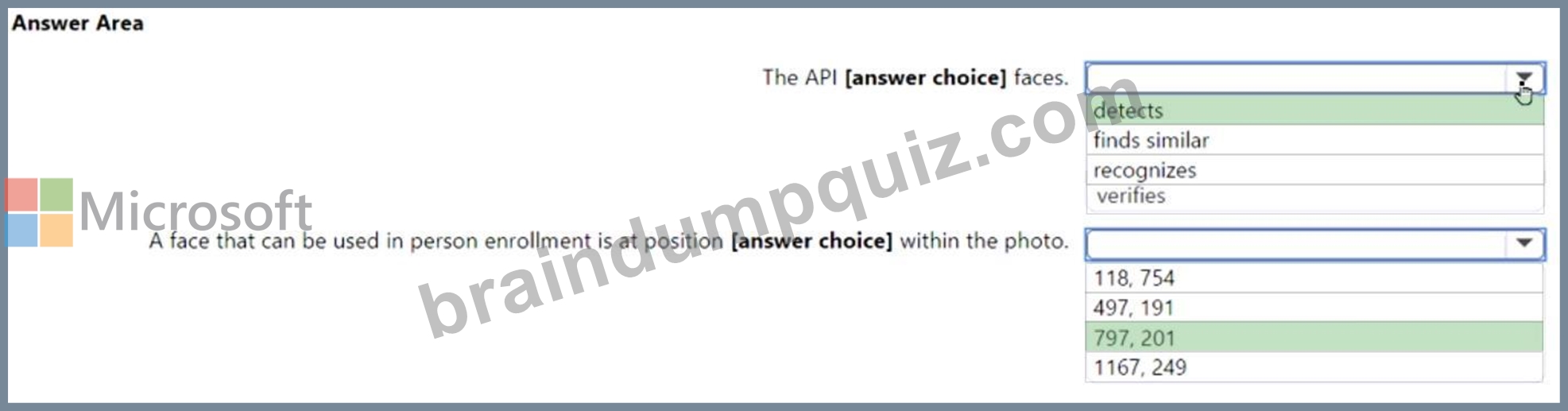
NEW QUESTION # 56
Hotspot Question
Select the answer that correctly completes the sentence.
Answer:
Explanation:
NEW QUESTION # 57
You have 100 chatbots that each has its own Language Understanding model.
Frequently, you must add the same phrases to each model.
You need to programmatically update the Language Understanding models to include the new phrases.
How should you complete the code? To answer, drag the appropriate values to the correct targets. Each value may be used once, more than once, or not at all. You may need to drag the split bar between panes or scroll to view content.
NOTE: Each correct selection is worth one point.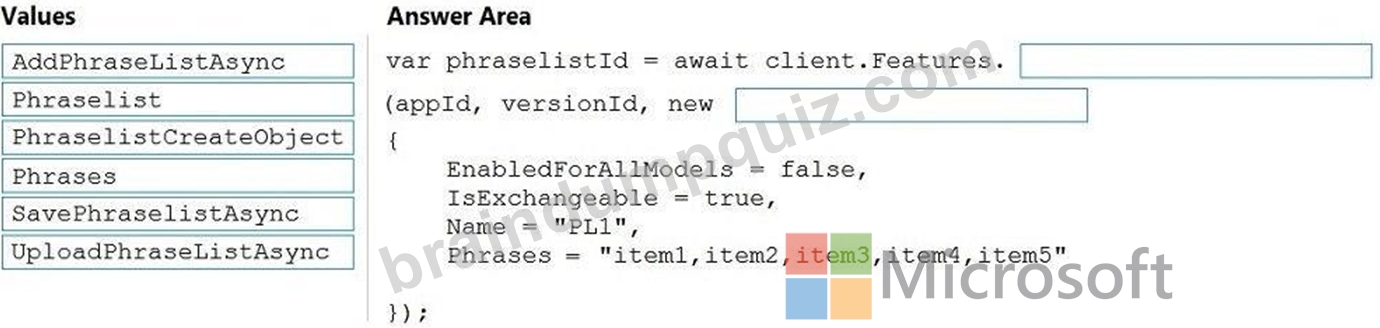
Answer:
Explanation: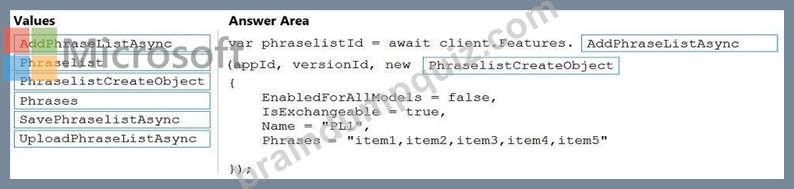
Box 1: AddPhraseListAsync
Example: Add phraselist feature
var phraselistId = await client.Features.AddPhraseListAsync(appId, versionId, new PhraselistCreateObject
{
EnabledForAllModels = false,
IsExchangeable = true,
Name = "QuantityPhraselist",
Phrases = "few,more,extra"
});
Box 2: PhraselistCreateObject
Reference:
https://docs.microsoft.com/en-us/azure/cognitive-services/luis/client-libraries-rest-api
NEW QUESTION # 58
You have an Azure Cognitive Search solution and a collection of blog posts that include a category field. You need to index the posts. The solution must meet the following requirements:
* Include the category field in the search results.
* Ensure that users can search for words in the category field.
* Ensure that users can perform drill down filtering based on category.
Which index attributes should you configure for the category field?
- A. searchable, facetable, and retrievable
- B. searchable, sortable, and retrievable
- C. retrievable, facetable, and key
- D. retrievable, filterable, and sortable
Answer: D
NEW QUESTION # 59
You have a web app that uses Azure AI search.
When reviewing activity, you see greater than expected search query volumes. You suspect that the query key is compromised.
You need to prevent unauthorized access to the search endpoint and ensure that users only have read only access to the documents collection. The solution must minimize app downtime.
Which three action should you perform in sequence? To answer, more the appropriate actions from the list of actions to the answer area and arrange them in the correct order.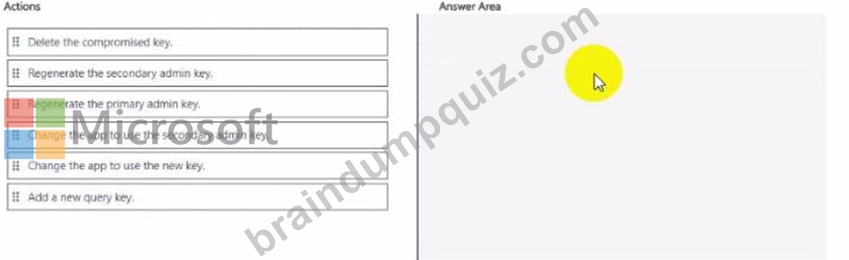
Answer:
Explanation: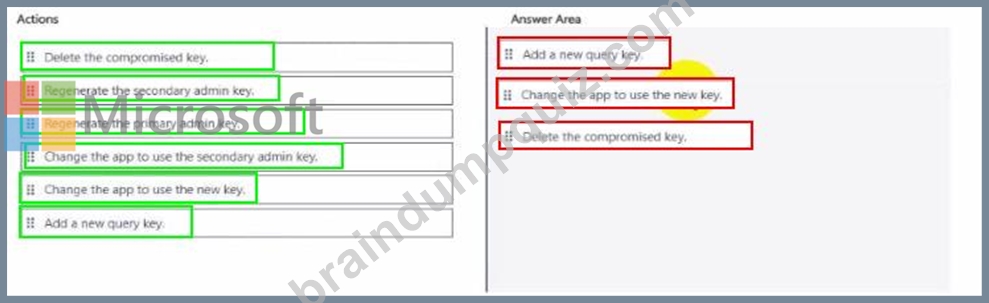
NEW QUESTION # 60
You are building a chatbot by using the Microsoft Bot Framework SDK. The bot will be used to accept food orders from customers and allow the customers to customize each food item.
You need to configure the bot to ask the user for additional input based on the type of item ordered. The solution must minimize development effort.
Which two types of dialogs should you use? Each correct answer presents part of the solution.
NOTE: Each correct selection is worth one point.
- A. input
- B. adaptive
- C. waterfall
- D. prompt
- E. action
Answer: C,D
Explanation:
https://learn.microsoft.com/en-us/azure/bot-service/bot-builder-concept-dialog?view=azure-bot- service-4.0#dialog-types
NEW QUESTION # 61
You have the following Python function.
You call the function by using the following code.
my_function(text_analytics_client, "the quick brown fox jumps over the
lazy dog")
Following 'Key phrases', what output will you receive?
- A. The quick -
The lazy - B. the quick brown fox jumps over the lazy dog
- C. quick brown fox
lazy dog - D. jumps over the
Answer: C
NEW QUESTION # 62
Note: This question is part of a series of questions that present the same scenario. Each question in the series contains a unique solution that might meet the stated goals. Some question sets might have more than one correct solution, while others might not have a correct solution.
After you answer a question in this section, you will NOT be able to return to it. As a result, these questions will not appear in the review screen.
You are building a chatbot that will use question answering in Azure Cognitive Service for Language.
You have a PDF named Doc1.pdf that contains a product catalogue and a price list You upload Doc1.pdf and train the model.
During testing, users report that the chatbot responds correctly to the following question: What is the price of
<product>?
The chatbot fails to respond to the following question: How much does < product > cost?
You need to ensure that the chatbot responds correctly to both questions.
Solution: From Language Studio, you add alternative phrasing to the question and answer pair, and then retrain and republish the model.
Does this meet the goal?
- A. No
- B. Yes
Answer: B
Explanation:
In Question Answering (Custom question answering in Azure AI Language), you improve coverage for different user phrasings by adding alternative questions to the same answer. For example, adding "How much does <product> cost?" as an alternate question to the existing Q/A about "What is the price of <product>?" enables the service to match both user queries to the same answer. After adding alternates, you must retrain and republish the project for changes to take effect. This directly addresses the gap and meets the goal.
References
* Add and manage alternative questions in custom question answering; retrain/republish for updates.
https://learn.microsoft.com/azure/ai-services/language-service/question-answering/how-to/contribute-to- project
* Custom question answering concepts and authoring workflow.https://learn.microsoft.com/azure/ai- services/language-service/question-answering/overview
NEW QUESTION # 63
For each of the following statements, select Yes if the statement is true. Otherwise, select No.
NOTE: Each correct selection is worth one point.
Answer:
Explanation:
Explanation
NEW QUESTION # 64
Note: This question is part of a series of questions that present the same scenario. Each question in the series contains a unique solution that might meet the stated goals. Some question sets might have more than one correct solution, while others might not have a correct solution.
After you answer a question in this section, you will NOT be able to return to it. As a result, these questions will not appear in the review screen.
You have a chatbot that uses question answering in Azure Cognitive Service for Language.
Users report that the responses of the chatbot lack formality when answering spurious questions.
You need to ensure that the chatbot provides formal responses to spurious questions.
Solution: From Language Studio, you change the chitchat source to
qna_chitchat_professional.tsv, and then retrain and republish the model.
Does this meet the goal?
- A. No
- B. Yes
Answer: B
NEW QUESTION # 65
You are building a retail chatbot that will use a QnA Maker service.
You upload an internal support document to train the model. The document contains the following question "What is your warranty period?" Users report that the chatbot returns the default QnA Maker answer when they ask the following question "How long is the warranty coverage?" The chatbot returns the correct answer when the users ask the following question 'What is your warranty period?" Both questions should return the same answer.
You need to increase the accuracy of the chatbot responses.
Which three actions should you perform in sequence? To answer, move the appropriate actions from the list of actions to the answer area and arrange them in the correct order. (Choose three.)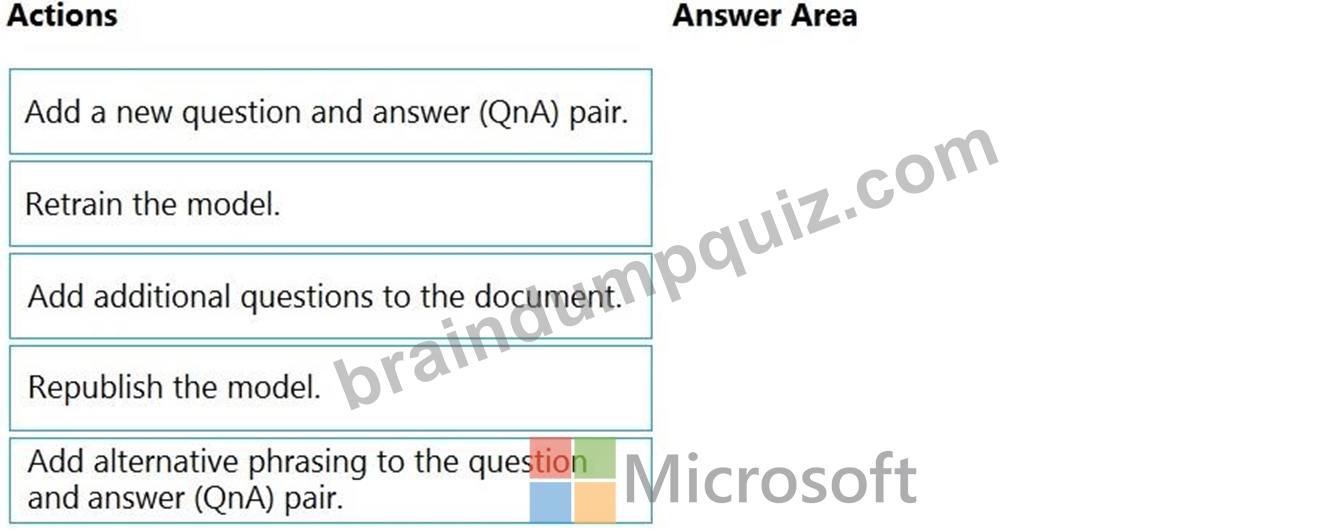
Answer:
Explanation: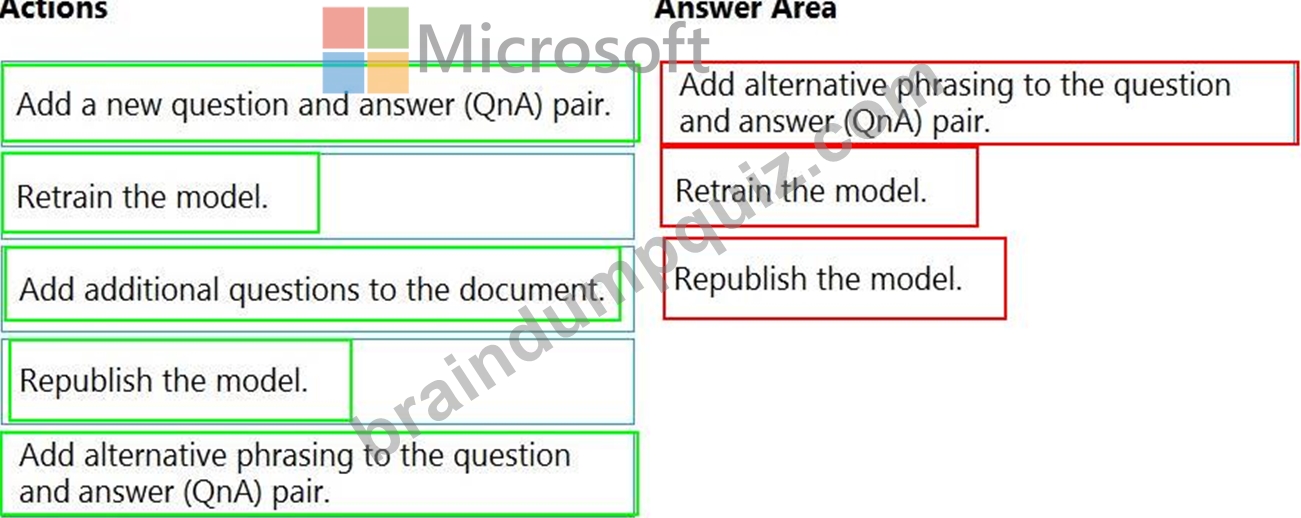
Reference:
https://docs.microsoft.com/en-us/azure/cognitive-services/qnamaker/how-to/edit-knowledge-base
NEW QUESTION # 66
You manage an application that stores data in a shared folder on a Windows server. You need to move the shared folder to Azure Storage. Which type of Azure Storage should you use?
- A. queue
- B. table
- C. file
- D. blob
Answer: C
Explanation:
The application stores data in a shared folder on a Windows server. The equivalent in Azure Storage is Azure Files, which provides:
* Fully managed file shares in the cloud.
* Support for the SMB (Server Message Block) protocol, so they can be mounted like traditional shared folders.
* Easy migration of on-premises file shares to Azure.
Other storage options:
* Table # NoSQL key-value store, not for file shares.
* Queue # For message storage and processing, not files.
* Blob # For unstructured object storage, but not mountable as a shared drive.
Therefore, Azure File Storage is correct.
Microsoft Reference: Azure Files overview
NEW QUESTION # 67
You have a Computer Vision resource named contoso1 that is hosted in the West US Azure region.
You need to use contoso1 to make a different size of a product photo by using the smart cropping feature.
How should you complete the API URL? To answer, select the appropriate options in the answer area.
NOTE: Each correct selection is worth one point.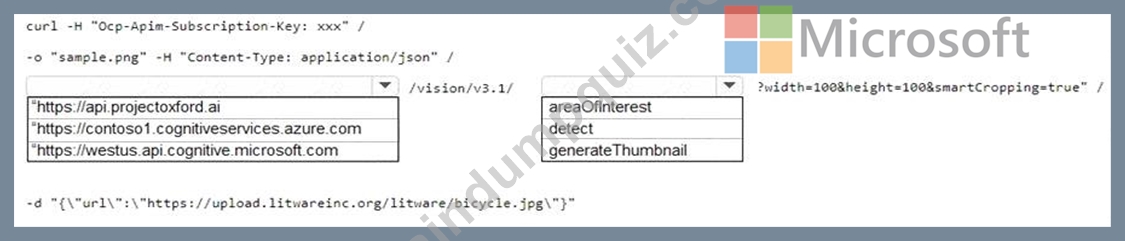
Answer:
Explanation: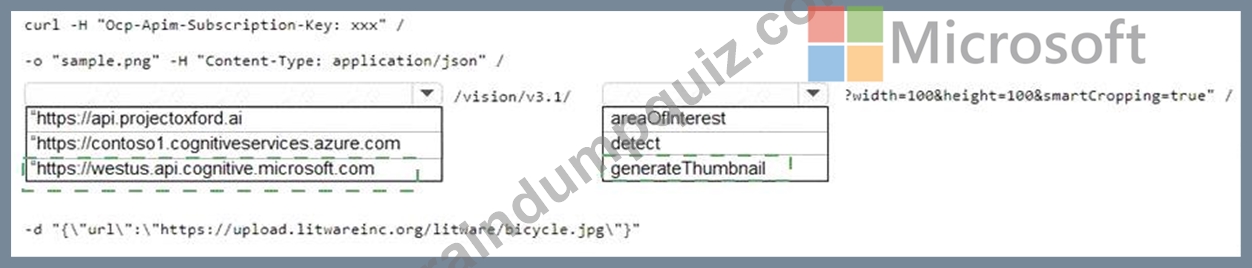
Explanation:
westus.api.cognitive.microsoft.com
generateThumbnail
https://docs.microsoft.com/en-us/rest/api/computervision/3.1/generate-thumbnail/generate-thumbnail#examples POST
https://westus.api.cognitive.microsoft.com/vision/v3.1/generateThumbnail?width=500&height=500&smartCropp Ocp-Apim-Subscription-Key: {API key}
NEW QUESTION # 68
You develop a test method to verify the results retrieved from a call to the Computer Vision API. The call is used to analyze the existence of company logos in images. The call returns a collection of brands named brands.
You have the following code segment.
For each of the following statements, select Yes if the statement is true. Otherwise, select No.
NOTE: Each correct selection is worth one point.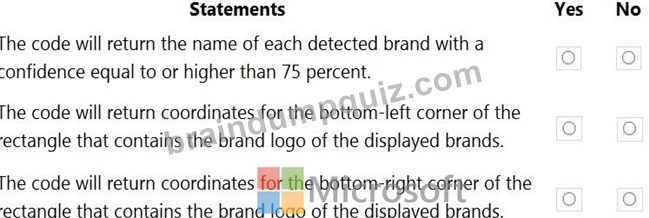
Answer:
Explanation: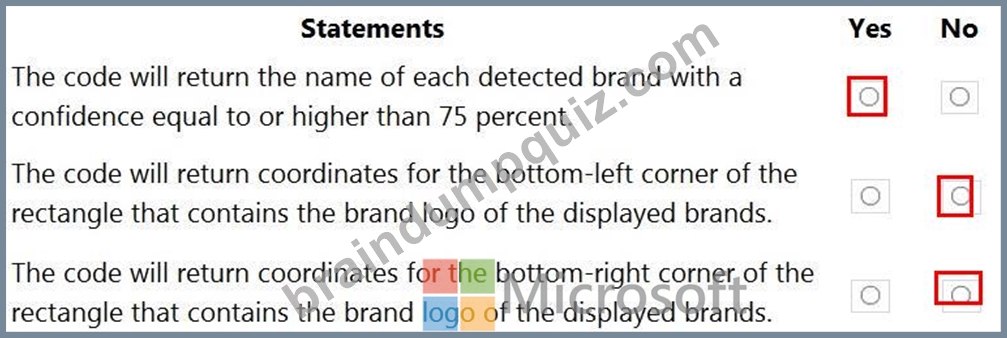
Reference:
https://docs.microsoft.com/en-us/azure/cognitive-services/computer-vision/concept-detecting-faces
NEW QUESTION # 69
You are building an app that will enable users to upload images. The solution must meet the following requirements:
* Automatically suggest alt text for the images.
* Detect inappropriate images and block them.
* Minimize development effort.
You need to recommend a computer vision endpoint for each requirement.
What should you recommend? To answer, select the appropriate options in the answer area.
NOTE: Each correct selection is worth one point.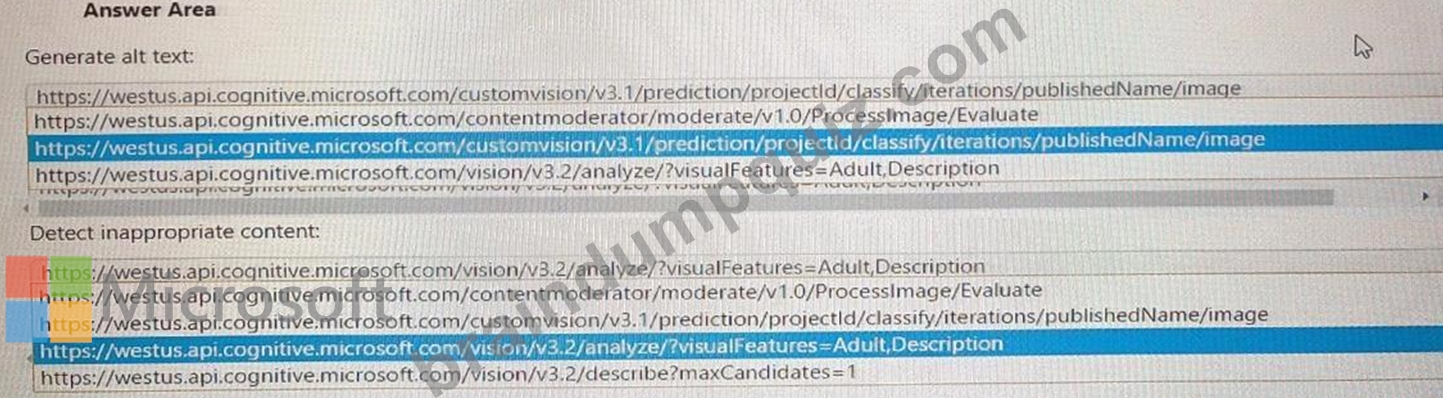
Answer:
Explanation: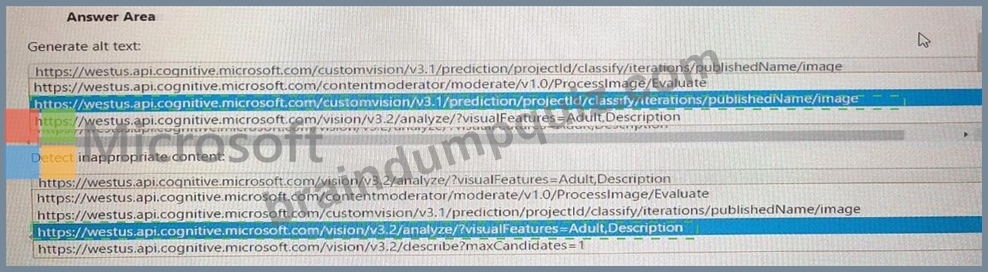
NEW QUESTION # 70
You have an Azure OpenAI model.
You have 500 prompt-completion pairs that will be used as training data to fine-tune the model.
You need to prepare the training data.
Which format should you use for the training data file?
- A. JSONL
- B. TSV
- C. CSV
- D. XML
Answer: A
NEW QUESTION # 71
You develop a test method to verify the results retrieved from a call to the Computer Vision API. The call is used to analyze the existence of company logos in images. The call returns a collection of brands named brands.
You have the following code segment.
For each of the following statements, select Yes if the statement is true. Otherwise, select No.
NOTE: Each correct selection is worth one point.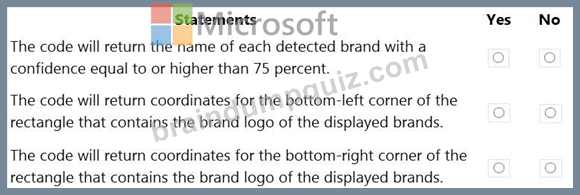
Answer:
Explanation: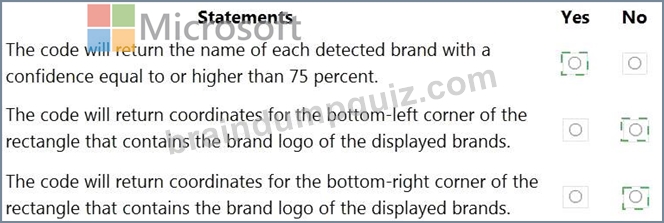
Explanation:
Box 1: Yes
Box 2: Yes
Box 3: No
Reference:
https://docs.microsoft.com/en-us/azure/cognitive-services/computer-vision/concept-detecting-faces
NEW QUESTION # 72
You are building a chatbot by using the Microsoft Bot Framework Composer.
You have the dialog design shown in the following exhibit.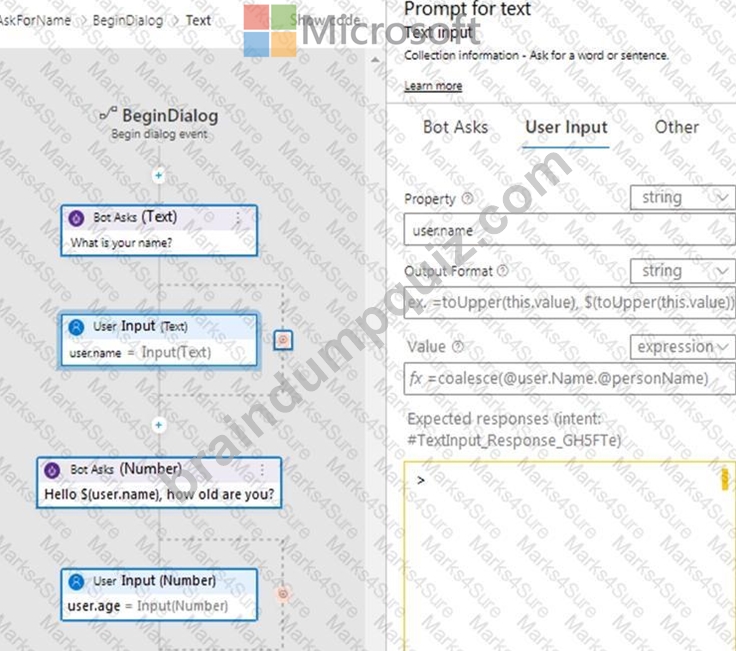
For each of the following statements, select Yes if the statement is true. Otherwise, select No.
NOTE: Each correct selection is worth one point.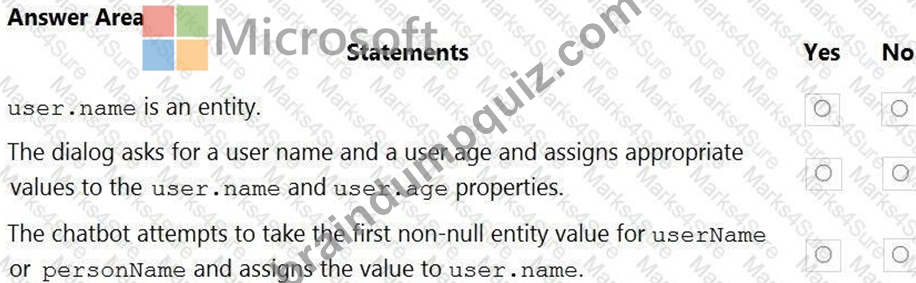
Answer:
Explanation: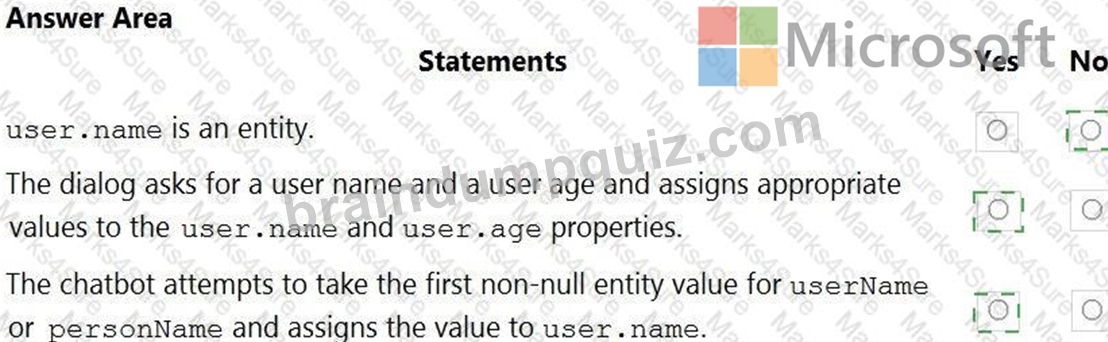
Explanation: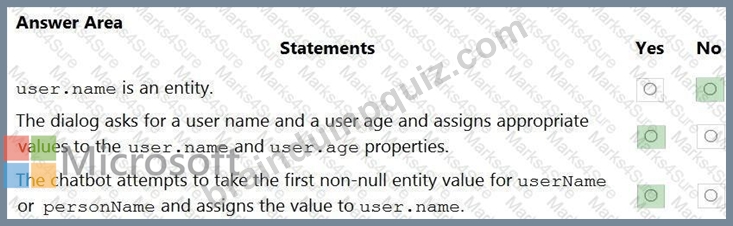
Box 1: No
User.name is a property.
Box 2: Yes
Box 3: Yes
The coalesce() function evaluates a list of expressions and returns the first non-null (or non-empty for string) expression.
Reference:
https://docs.microsoft.com/en-us/composer/concept-language-generation
https://docs.microsoft.com/en-us/azure/data-explorer/kusto/query/coalescefunction
NEW QUESTION # 73
You are building a chatbot by using the Microsoft Bot Framework SDK.
You use an object named UserProfile to store user profile information and an object named ConversationData to store information related to a conversation.
You create the following state accessors to store both objects in state.
var userStateAccessors = _userState.CreateProperty<UserProfile>(nameof(UserProfile)); var conversationStateAccessors =
_conversationState.CreateProperty<ConversationData>(nameof(ConversationData)); The state storage mechanism is set to Memory Storage.
For each of the following statements, select Yes if the statement is true. Otherwise, select No.
NOTE: Each correct selection is worth one point.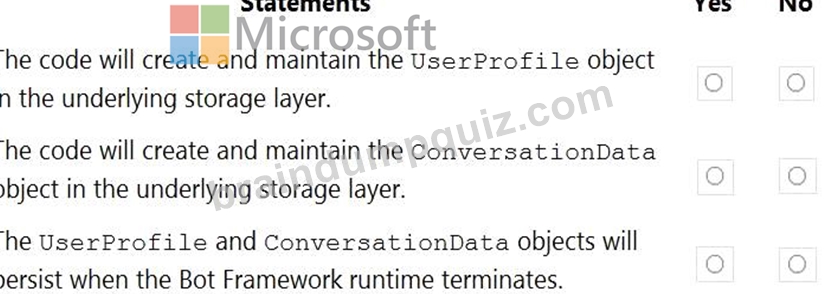
Answer:
Explanation: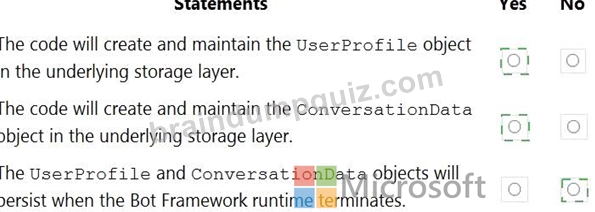
Explanation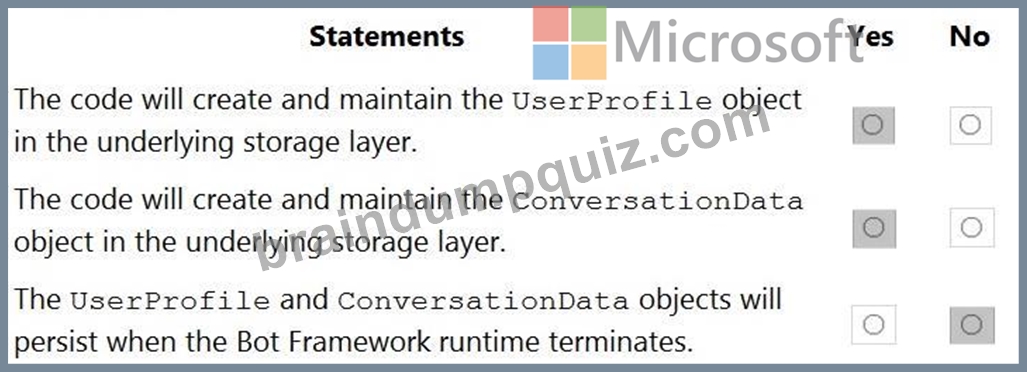
Box 1: Yes
You create property accessors using the CreateProperty method that provides a handle to the BotState object.
Each state property accessor allows you to get or set the value of the associated state property.
Box 2: Yes
Box 3: No
Before you exit the turn handler, you use the state management objects' SaveChangesAsync() method to write all state changes back to storage.
Reference:
https://docs.microsoft.com/en-us/azure/bot-service/bot-builder-howto-v4-state
NEW QUESTION # 74
You run the following command.
For each of the following statements, select Yes if the statement is true. Otherwise, select No.
Answer:
Explanation: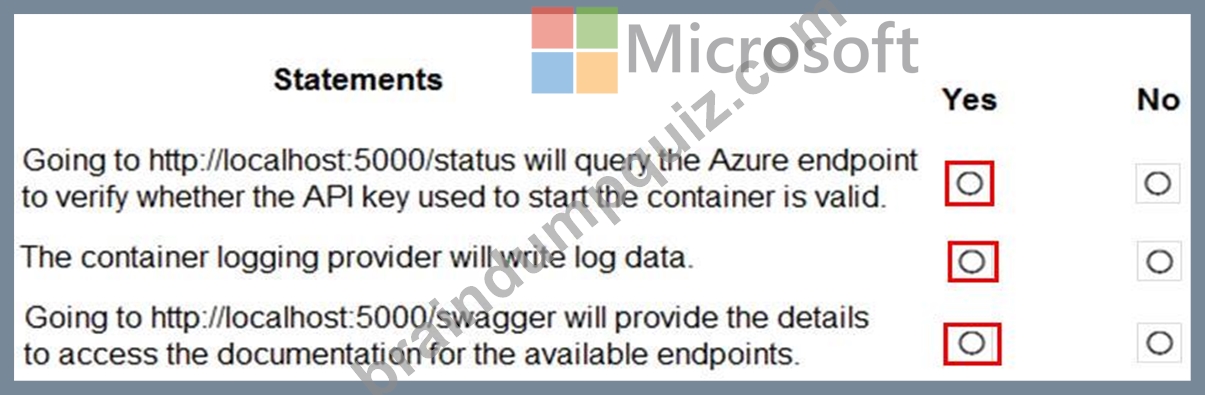
Reference:
https://docs.microsoft.com/en-us/azure/cognitive-services/luis/luis-container-howto
NEW QUESTION # 75
You are developing a text processing solution.
You develop the following method.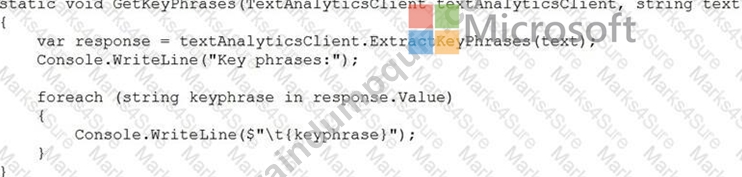
You call the method by using the following code.
GetKeyPhrases(textAnalyticsClient, "the cat sat on the mat");
For each of the following statements, select Yes if the statement is true. Otherwise, select No.
NOTE: Each correct selection is worth one point.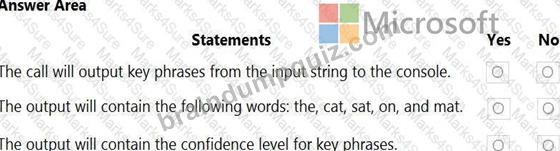
Answer:
Explanation: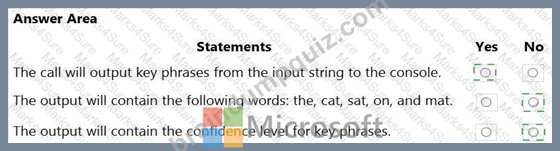
Explanation: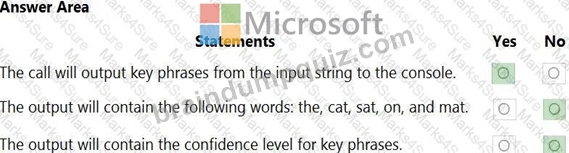
Box 1: Yes
The Key Phrase Extraction API evaluates unstructured text, and for each JSON document, returns a list of key phrases.
Box 2: No
'the' is not a key phrase.
This capability is useful if you need to quickly identify the main points in a collection of documents. For example, given input text "The food was delicious and there were wonderful staff", the service returns the main talking points: "food" and "wonderful staff".
Box 3: No
Key phrase extraction does not have confidence levels.
Reference:
https://docs.microsoft.com/en-us/azure/cognitive-services/text-analytics/how-tos/text-analytics-how-to-keyword-
NEW QUESTION # 76
......
Microsoft AI-102 (Designing and Implementing a Microsoft Azure AI Solution) Exam is a certification exam that focuses on testing the skills and knowledge of a candidate in designing and implementing AI solutions using Microsoft Azure. AI-102 exam is intended for individuals who have experience in working with Azure AI services and tools and want to obtain an official certification from Microsoft.
Pass Microsoft AI-102 Exam Info and Free Practice Test: https://interfacett.braindumpquiz.com/AI-102-exam-material.html