

CTAL-TM_Syll2012 Practice Test Questions Updated 66 Questions
ISQI CTAL-TM_Syll2012 Dumps - Secret To Pass in First Attempt
NEW QUESTION 20
Reviews
You are the Test Manager of a project that adopts a V-model with four formal levels of testing: unit, integration, system and acceptance testing.
On this project reviews have been conducted for each development phase prior to testing, which is to say that reviews of requirements, functional specification, high-level design, low-level design and code have been performed prior to testing.
Assume that no requirements defects have been reported after the release of the product.
Which TWO of the following metrics do you need in order to evaluate the requirements reviews in terms of phase containment effectiveness?
- A. Total number of defects found during functional specification review, high-level design review, low-level design review, code review, unit testing, integration testing, system testing and acceptance testing
- B. Time to conduct the requirements review
- C. Total number of defects attributable to requirements found during unit, integration, system and acceptance testing
- D. Number of defects found during the requirements review
- E. Total number of defects attributable to requirements, found during functional specification review, high- level design review, low-level design review, code review, unit testing, integration testing, system testing and acceptance testing
Answer: D,E
NEW QUESTION 21
Assume you are the Test Manager in charge of independent testing for avionics applications.
You are in charge of testing for a project to implement three different CSCI (Computer Software Configuration Item):
-
a BOOT-X CSCI that must be certified at level B of the DO-178B standard
-
a DIAG-X CSCI that must be certified at level C of the DO-178B standard
-
a DRIV-X CSCI that must be certified at level A of the DO-178B standard
These are three different software modules written in C language to run on a specific hardware platform.
You have been asked to select a single code coverage tool to perform the mandatory code coverage measurements, in order to meet the structural coverage criteria prescribed by the DO178B standard. This tool must be qualified as a verification tool under DO-178B.
Since there are significant budget constraints to purchase this tool, you are evaluating an open-source tool that is able to provide different types of code coverage. This tool meets perfectly your technical needs in terms of the programming language and the specific hardware platform (it supports also the specific C-compiler).
The source code of the tool is available.
Your team could easily customize the tool to meet the project needs. This tool is not qualified as a verification tool under the DO-178B.
Which of the following are the three main concerns related to that open-source tool selection?
K4 3 credits (2 credits out of 3 credits correct, 1 credit point)
- A. Does the tool require a system with more than 4GB of RAM memory?
- B. Does the tool support all the types of code coverage required from the three levels A, B, C of the DO-178B standard?
- C. Is the licensing scheme of the tool compatible with the confidentiality needs of the avionics company?
- D. Is the installation procedure of the tool easy?
- E. What are the costs to qualify the tool as a verification tool under the DO-178B?
- F. Does the tool have a good general usability?
Answer: B,C,E
NEW QUESTION 22
Test Management
You are working on a project to develop an authentication system for an e-commerce website. This system provides two features: Registration and authentication. Two different development teams develop these two features.
There is a high likelihood that the delivery of the authentication feature to the test team will be three weeks later. To complete the registration the user must provide the following registration inputs: Name, surname, birthdate, fiscal code and he/she can select a username and a password.
A registered user can be a special user or a normal user. To be identified as a special user, he/she must also provide, during the registration process, a voucher possibly received from the IT department.
Access is granted only if a user is registered and the password is correct: In all other cases access is denied. If the registered user is a special user and the password is wrong, a special warning is shown on the system console.
You are currently performing a quality risk analysis using FMEA.
Based only on the given information, which of the following is NOT a product risk that could be identified during the quality risk analysis?
- A. The authentication system grants access to a special user with a wrong password
- B. The authentication system denies access for a special user with a wrong password, but doesn't display a special warning on the system console
- C. The authentication system grants access to a normal user with a wrong password
- D. The late delivery of the authentication feature to the test team causes delays in the start of test execution and this could result in a shorter test period
Answer: D
Explanation:
Section: Test Management
NEW QUESTION 23
The following chart plots the cumulative number of defects opened against the cumulative number of defects closed during system testing of a software product.
Which of the following statements is true? K2 1 credit
- A. The chart indicates that you have plenty of problems left to find
- B. The chart can be used to reveal test progress problems
- C. The chart seems to indicate that the defect management process is working well
- D. The chart seems to indicate that the defect management process is not working well
Answer: C
NEW QUESTION 24
Testing Process
Assume you are the Test Manager for a new software release of an e-commerce application.
The server farm consists of six servers providing different capabilities. Each capability is provided through a set of web services.
The requirements specification document contains several SLAs (Service Level Agreements) like the following:
SLA-001: 99.5 percent of all transactions shall have a response time less than five seconds under a load of up- to 5000 concurrent users The main objective is to assure that all the SLAs specified in the requirements specification document will be met before system release. You decide to apply a risk-based testing strategy and an early risk analysis confirms that performance is high risk. You can count on a well-written requirements specification and on a model of the system behavior under various load levels produced by the system architect.
Which of the following test activities would you expect to be the less important ones to achieve the test objectives in this scenario?
- A. Perform static performance testing by reviewing the architectural model of the system under various load levels
- B. Perform unit performance testing for each single web service
- C. Perform system performance testing, consisting of several performance testing sessions, to verify if all the SLAs have been met
- D. Monitor the SLAs after the system has been released into the production environment
Answer: D
Explanation:
Section: Testing Process
NEW QUESTION 25
You are the Test Manager on a project following an iterative life-cycle model. The project should consist of nine iterations of one month duration each. It is planned to develop the most important features to have a stable core of the application in the first three iterations and to add the additional features in the last six iterations.
At the beginning of the first iteration, only a draft version of the requirements specification document for the core features is available. Assume that during each of the first three iterations, the chosen features are fully completed and unit tested.
Which of the following statements is true in this context?
K4 3 credits
- A. You should apply the same test strategy as used in a sequential life cycle model
- B. The system test phase should start when all the requirements are frozen
- C. You should allocate all the effort for the system test phase only in the last iteration
- D. You should allocate a large effort for system testing during the first three iterations
Answer: D
NEW QUESTION 26
People Skills - Team Composition
Your test team consists of four members (Mary, Bob, Mark, Dave) with different interpersonal skills.
The following skills assessment spreadsheet shows the characteristics of the team members with respect to a list of interpersonal-skills (for each characteristic only the member with the highest level of that characteristic is indicated and marked with 'X'):
On the next project a member of your test team will have to perform some routine tasks requiring collaboration with other teams.
Who in your test team would you expect to be most suitable at doing these tasks?
Number of correct responses: 1
K4 3 credits
- A. Mary
- B. Dave
- C. Bob
- D. Mark
Answer: A
NEW QUESTION 27
Consider the following test strategies:
I. Consultative test strategy
II. Reactive test strategy
III. Analytical test strategy
IV. Process-compliant test strategy
Consider also the following examples of test activities:
1.Prioritize the test cases, based on the results of a FMEA analysis, to ensure early coverage of the most important areas and discovery of the most important defects during test execution
2.Execute usability testing driven by the guidance of a sample of users (external to the test team)
3.Perform exploratory testing sessions throughout the system test phase
4.On an Agile project, execute tests that cover the test conditions identified for each user story of a feature planned for an iteration
Which of the following correctly matches each test strategy with an appropriate example?
K2 1 credit
- A. I-2; II-3; III-1; IV-4
- B. I-2; II-3; III-4; IV-1
- C. I-3; II-2; III-1; IV-4
- D. I-1; II-2; III-3; IV-4
Answer: A
NEW QUESTION 28
You are estimating the effort for the integration testing activities of a new project. Consider the following factors, which can affect that estimation:
I. Availability of re-usable test systems and documentation from previous, similar projects
II. Unexpected timing of components arrival
III. Stability of the integration test team (no turnover)
IV. Many and geographically distributed sub-teams Which of the following statements is true?
K2 1 credit
- A. II. and III. can negatively affect the estimation
- B. and III. usually favor the accuracy of the estimation effort
- C. II. and IV. can negatively affect the estimation
- D. and II. usually favor the accuracy of the estimation effort
- E. III. and IV. can negatively affect the estimation
- F. and IV. usually favor the accuracy of the estimation effort
- G. I. and II. can negatively affect the estimation III. and IV. usually favor the accuracy of the estimation effort
Answer: F
NEW QUESTION 29
Defect Management
Assume you are working on a defect management process to be used by a software organization to track the current status of the defects reports for several projects.
When a defect is found for investigation a defect report is created in "Opened" state that is the unique initial state. The defect report status has also a unique finale state that is the "Closed" state.
The following state transition diagram describes the states of this defect management process: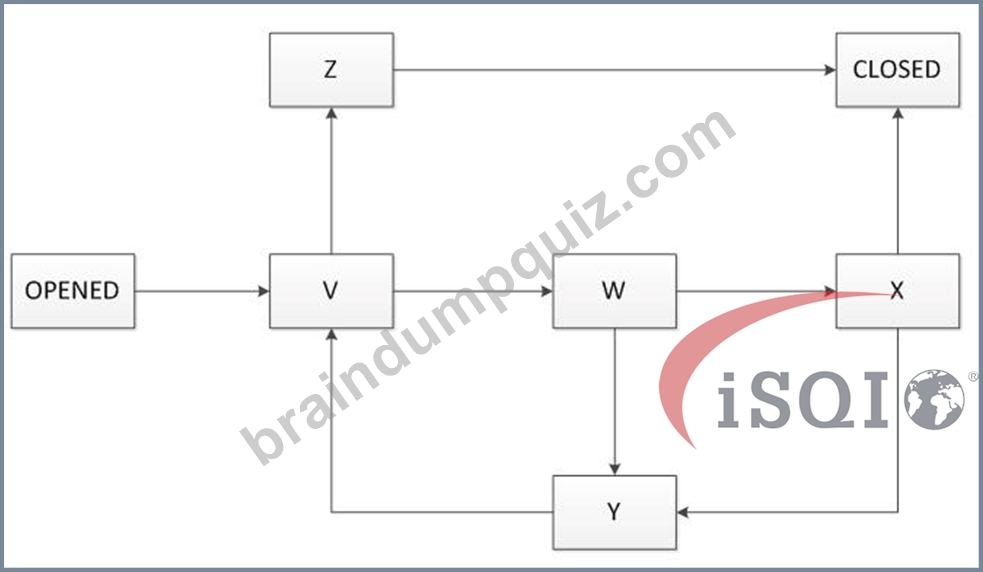
where only the initial ("Opened") and final ("Closed") states are indicated while the remaining states (V, W, X, Y, Z) have yet to be named.
Which of the following assignments would you expect to best complete the defect management process?
- A. V=Assigned, W=Validated , X=Corrected, Y=Re-Opened, Z=Rejected
- B. V=Rejected , W=Corrected , X=Validated, Y=Re-Opened, Z=Assigned
- C. V=Assigned, W=Corrected , X=Validated, Y=Re-Opened, Z=Rejected
- D. V= Corrected, W=Assigned, X=Validated, Y=Corrected, Z=Rejected
Answer: C
NEW QUESTION 30
Test Management
Based on the historical data of 5 past and similar projects, you have calculated these average numbers of defects detected in system testing:
- for each 10000 LOC (lines of code), 200 defects
- for each person-month of development team effort, 49 defects
You want to use this information to perform estimation for a new project.
The project manager tells you that he/she has estimated 20000 new LOC for this new project.
Four developers work for four months on this project before system testing.
During system testing, 797 defects are discovered.
Assume that the system test of this new project is using the same amount of work as spent in the past projects.
Based on this information only, which of the following statement is certainly true about this project?
Number of correct responses: 1
K3 3 credits
- A. More LOC than planned have been delivered to system testing with a higher defect density than the past projects
- B. 40000 LOC have been delivered to system testing (against the 20000 LOC planned by the project manager)
- C. The code for the new project contains a higher defect density than the code of the past projects
- D. The number of defects found during the system test phase on the new project is approximately proportional to the development team effort
Answer: D
NEW QUESTION 31
You are using this skills assessment spreadsheet in order to define a training development plan for your test team.
Your objective is to fill the skill gaps by having at least a team member rated as an expert for each skill identified for the "technical expertise" and "testing skills" sections, and with the ability to train the other team members.
Considering the budget constraints you can send only one person to a training course.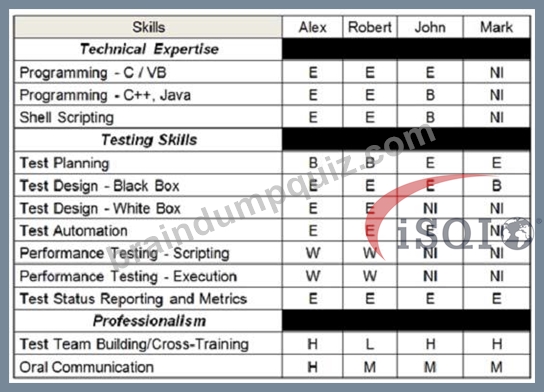
Based only on the given information, which of the following answers would you expect to be the best option to achieve your objective?
- A. Send John to a performance testing training course
- B. Send Robert to a performance testing training course
- C. Send Mark to a test automation training course
- D. Send Alex to a performance testing training course
Answer: D
NEW QUESTION 32
Defect Management
During the system testing phase a tester from your test team observes a failure in the system under test and he/she decides to create an incident report. The incident report is currently in a "new" state, indicating it needs to be investigated.
Which THREE of the following information items can't yet be present in the incident report?
- A. What really caused the failure (actual cause)
- B. The actual and the expected result highlighting the failure
- C. The type of defect that caused the failure
- D. The lifecycle phase in which the defect has been introduced
- E. Steps to reproduce the failure, including screenshots, database dumps and logs where applicable
Answer: A,C,D
NEW QUESTION 33
Test Management
You are the Test Manager of a new project that will have three formal levels of testing: unit, integration and system testing. The testing strategy you decide to adopt a blend of risk-based testing and reactive testing strategies.
Which of the following answers describes the most consistent example of implementation of this test strategy during the execution of the system tests?
Number of correct responses: 1
K2 1 credit
- A. Your test team executes scripted tests designed and implemented before the execution of the system test phase, to cover the identified product risks. It also performs exploratory testing sessions throughout the system test phase
- B. Your test team autonomously performs some exploratory testing sessions and, at the very end of the system testing phase, it also executes more system tests under the guidance of a sample of users
- C. Your test team executes exploratory tests following a session-based test management approach throughout the system test phase
- D. Your test team executes system tests under the guidance of a sample of users throughout the system test phase
Answer: A
NEW QUESTION 34
An agile development team decides to hire a tester who has always workeD.
-
in independent test teams, reporting the problems found in a defect tracking system
-
in safety-critical projects, with a stronger focus on the quality of the product than on time and budget.
This agile team is focused on short-term goals to get the product released on time and within budget.
Which of the following answers would you expect to be most likely true in this scenario?
K2 1 credit
- A. The tester can continue to report the problems found in a defect tracking system and be more focused on the quality than on time and budget constraints
- B. The developers will immediately follow the guidelines described by the tester
- C. Agile teams like the presence of a tester in their teams and the tester will be able to adapt to the new context without any issue
- D. The tester's mission could be to verify adherence to requirements, instead of reporting formally the problems in a defect tracking system
Answer: D
NEW QUESTION 35
You are a Test Manager working for a software organization where reviews have never been applied. After a meeting with your managers examining a business case for reviews, (including their costs, benefits, and potential issues), the management finally decides to adopt formal reviews for future projects.
You have been given a budget that you have spent to provide training in the review process and to introduce the review process on a pilot project.
On that pilot project the introduction of reviews has been very positive in terms of positive involvement from all the participants. All the reviews applied to different documents have been very effective for their purposes (especially at revealing defects).
Which of the following answers describes an important success factor for the introduction of formal reviews which is missing in this scenario?
K4 3 credits
- A. Definition and use of metrics to measure the ROI (Return On Investment)
- B. Participant support
- C. Management support
- D. Training in the review process
Answer: A
NEW QUESTION 36
The main objectives the senior management team wants to achieve are:
- to reduce the costs associated with dynamic testing
- to use reviews to ensure that the project is on course for success and following the plan
- to use reviews as a well-documented and effective bug-removal activity following a formal process with well-defined roles
- to determine the effectiveness of reviews in terms of phase containment
- to improve phase containment effectiveness
Which of the following answers would you expect to describe the best way to achieve these objectives?
Number of correct responses: 1
K4 3 credits
- A. You should plan for lightweight exit-phase reviews at the end of each development and testing phase, and plan for a process of gathering information from testing to perform an analysis aimed at identifying the larger cluster of defects
- B. You should plan for formal exit-phase reviews at the end of each development and testing phase, and plan for a process of gathering information from testing to perform an analysis aimed at identifying the larger cluster of defects
- C. You should plan for formal exit-phase reviews at the end of each development phase and testing phase, and plan for a process of gathering information from testing to perform an analysis of the bugs found during testing to determine the people responsible for those bugs
- D. You should plan for formal exit-phase reviews at the end of each development and testing phase, and plan for a process of gathering information from testing to perform an analysis of the bugs found during testing to determine the phase in which they have been introduced
Answer: D
NEW QUESTION 37
......
ISQI CTAL-TM_Syll2012 Exam Dumps [2022] Practice Valid Exam Dumps Question: https://interfacett.braindumpquiz.com/CTAL-TM_Syll2012-exam-material.html