

Download the Latest DP-203 Dumps - 2022 DP-203 Exam Questions
Latest Microsoft DP-203 Certification Practice Test Questions
NEW QUESTION 119
You have two Azure Data Factory instances named ADFdev and ADFprod. ADFdev connects to an Azure DevOps Git repository.
You publish changes from the main branch of the Git repository to ADFdev.
You need to deploy the artifacts from ADFdev to ADFprod.
What should you do first?
- A. From Azure DevOps, create a release pipeline.
- B. From Azure DevOps, update the main branch.
- C. From ADFdev, create a linked service.
- D. From ADFdev, modify the Git configuration.
Answer: A
Explanation:
In Azure Data Factory, continuous integration and delivery (CI/CD) means moving Data Factory pipelines from one environment (development, test, production) to another.
Note:
The following is a guide for setting up an Azure Pipelines release that automates the deployment of a data factory to multiple environments.
In Azure DevOps, open the project that's configured with your data factory.
On the left side of the page, select Pipelines, and then select Releases.
Select New pipeline, or, if you have existing pipelines, select New and then New release pipeline.
In the Stage name box, enter the name of your environment.
Select Add artifact, and then select the git repository configured with your development data factory. Select the publish branch of the repository for the Default branch. By default, this publish branch is adf_publish.
Select the Empty job template.
Reference:
https://docs.microsoft.com/en-us/azure/data-factory/continuous-integration-deployment
NEW QUESTION 120
You have an enterprise data warehouse in Azure Synapse Analytics.
Using PolyBase, you create an external table named [Ext].[Items] to query Parquet files stored in Azure Data Lake Storage Gen2 without importing the data to the data warehouse.
The external table has three columns.
You discover that the Parquet files have a fourth column named ItemID.
Which command should you run to add the ItemID column to the external table?
- A. Option C
- B. Option D
- C. Option B
- D. Option A
Answer: A
Explanation:
https://docs.microsoft.com/en-us/sql/t-sql/statements/create-external-table-transact-sql
NEW QUESTION 121
You need to implement an Azure Databricks cluster that automatically connects to Azure Data Lake Storage Gen2 by using Azure Active Directory (Azure AD) integration.
How should you configure the new cluster? To answer, select the appropriate options in the answer area.
NOTE: Each correct selection is worth one point.
Answer:
Explanation:
References:
https://docs.azuredatabricks.net/spark/latest/data-sources/azure/adls-passthrough.html
NEW QUESTION 122
You have an on-premises data warehouse that includes the following fact tables. Both tables have the following columns: DateKey, ProductKey, RegionKey. There are 120 unique product keys and 65 unique region keys.
Queries that use the data warehouse take a long time to complete.
You plan to migrate the solution to use Azure Synapse Analytics. You need to ensure that the Azure-based solution optimizes query performance and minimizes processing skew.
What should you recommend? To answer, select the appropriate options in the answer area.
NOTE: Each correct selection is worth one point
Answer:
Explanation:
Reference:
https://docs.microsoft.com/en-us/azure/sql-data-warehouse/sql-data-warehouse-tables-distribute
NEW QUESTION 123
You configure monitoring for a Microsoft Azure SQL Data Warehouse implementation. The implementation uses PolyBase to load data from comma-separated value (CSV) files stored in Azure Data Lake Gen 2 using an external table.
Files with an invalid schema cause errors to occur.
You need to monitor for an invalid schema error.
For which error should you monitor?
- A. EXTERNAL TABLE access failed due to internal error: 'Java exception raised on call to HdfsBridge_Connect: Error [Unable to instantiate LoginClass] occurred while accessing external files.'
- B. EXTERNAL TABLE access failed due to internal error: 'Java exception raised on call to HdfsBridge_Connect: Error [No FileSystem for scheme: wasbs] occurred while accessing external file.'
- C. EXTERNAL TABLE access failed due to internal error: 'Java exception raised on call to HdfsBridge_Connect: Error
[com.microsoft.polybase.client.KerberosSecureLogin] occurred while accessing external files.' - D. Cannot execute the query "Remote Query" against OLE DB provider "SQLNCLI11": for linked server
"(null)", Query aborted- the maximum reject threshold (o
rows) was reached while regarding from an external source: 1 rows rejected out of total 1 rows processed.
Answer: D
Explanation:
Explanation
Customer Scenario:
SQL Server 2016 or SQL DW connected to Azure blob storage. The CREATE EXTERNAL TABLE DDL points to a directory (and not a specific file) and the directory contains files with different schemas.
SSMS Error:
Select query on the external table gives the following error:
Msg 7320, Level 16, State 110, Line 14
Cannot execute the query "Remote Query" against OLE DB provider "SQLNCLI11" for linked server
"(null)". Query aborted-- the maximum reject threshold (0 rows) was reached while reading from an external source: 1 rows rejected out of total 1 rows processed.
Possible Reason:
The reason this error happens is because each file has different schema. The PolyBase external table DDL when pointed to a directory recursively reads all the files in that directory. When a column or data type mismatch happens, this error could be seen in SSMS.
Possible Solution:
If the data for each table consists of one file, then use the filename in the LOCATION section prepended by the directory of the external files. If there are multiple files per table, put each set of files into different directories in Azure Blob Storage and then you can point LOCATION to the directory instead of a particular file. The latter suggestion is the best practices recommended by SQLCAT even if you have one file per table.
NEW QUESTION 124
You are designing a highly available Azure Data Lake Storage solution that will include geo-zone-redundant storage (GZRS).
You need to monitor for replication delays that can affect the recovery point objective (RPO).
What should you include in the monitoring solution?
- A. 5xx: Server Error errors
- B. Average Success E2E Latency
- C. availability
- D. Last Sync Time
Answer: D
Explanation:
Because geo-replication is asynchronous, it is possible that data written to the primary region has not yet been written to the secondary region at the time an outage occurs. The Last Sync Time property indicates the last time that data from the primary region was written successfully to the secondary region. All writes made to the primary region before the last sync time are available to be read from the secondary location. Writes made to the primary region after the last sync time property may or may not be available for reads yet.
Reference:
https://docs.microsoft.com/en-us/azure/storage/common/last-sync-time-get
NEW QUESTION 125
You have an Azure Data Lake Storage Gen2 account named adls2 that is protected by a virtual network.
You are designing a SQL pool in Azure Synapse that will use adls2 as a source.
What should you use to authenticate to adls2?
- A. a shared access signature (SAS)
- B. a shared key
- C. an Azure Active Directory (Azure AD) user
- D. a managed identity
Answer: D
NEW QUESTION 126
You are developing a solution using a Lambda architecture on Microsoft Azure.
The data at test layer must meet the following requirements:
Data storage:
* Serve as a repository (or high volumes of large files in various formats.
* Implement optimized storage for big data analytics workloads.
* Ensure that data can be organized using a hierarchical structure.
Batch processing:
* Use a managed solution for in-memory computation processing.
* Natively support Scala, Python, and R programming languages.
* Provide the ability to resize and terminate the cluster automatically.
Analytical data store:
* Support parallel processing.
* Use columnar storage.
* Support SQL-based languages.
You need to identify the correct technologies to build the Lambda architecture.
Which technologies should you use? To answer, select the appropriate options in the answer area NOTE: Each correct selection is worth one point.
Answer:
Explanation:
References:
https://docs.microsoft.com/en-us/azure/storage/blobs/data-lake-storage-namespace
https://docs.microsoft.com/en-us/azure/architecture/data-guide/technology-choices/batch-processing
https://docs.microsoft.com/en-us/azure/sql-data-warehouse/sql-data-warehouse-overview-what-is
NEW QUESTION 127
You use Azure Stream Analytics to receive Twitter data from Azure Event Hubs and to output the data to an Azure Blob storage account.
You need to output the count of tweets from the last five minutes every minute.
Which windowing function should you use?
- A. Tumbling
- B. Session
- C. Hopping
- D. Sliding
Answer: C
Explanation:
Hopping window functions hop forward in time by a fixed period. It may be easy to think of them as Tumbling windows that can overlap and be emitted more often than the window size. Events can belong to more than one Hopping window result set. To make a Hopping window the same as a Tumbling window, specify the hop size to be the same as the window size.
Reference:
https://docs.microsoft.com/en-us/azure/stream-analytics/stream-analytics-window-functions
NEW QUESTION 128
You are building an Azure Stream Analytics job to identify how much time a user spends interacting with a feature on a webpage.
The job receives events based on user actions on the webpage. Each row of data represents an event. Each event has a type of either 'start' or 'end'.
You need to calculate the duration between start and end events.
How should you complete the query? To answer, select the appropriate options in the answer area.
NOTE: Each correct selection is worth one point.
Answer:
Explanation:
Explanation
Box 1: DATEDIFF
DATEDIFF function returns the count (as a signed integer value) of the specified datepart boundaries crossed between the specified startdate and enddate.
Syntax: DATEDIFF ( datepart , startdate, enddate )
Box 2: LAST
The LAST function can be used to retrieve the last event within a specific condition. In this example, the condition is an event of type Start, partitioning the search by PARTITION BY user and feature. This way, every user and feature is treated independently when searching for the Start event. LIMIT DURATION limits the search back in time to 1 hour between the End and Start events.
Example:
SELECT
[user],
feature,
DATEDIFF(
second,
LAST(Time) OVER (PARTITION BY [user], feature LIMIT DURATION(hour,
1) WHEN Event = 'start'),
Time) as duration
FROM input TIMESTAMP BY Time
WHERE
Event = 'end'
Reference:
https://docs.microsoft.com/en-us/azure/stream-analytics/stream-analytics-stream-analytics-query-patterns
NEW QUESTION 129
You plan to create a real-time monitoring app that alerts users when a device travels more than 200 meters away from a designated location.
You need to design an Azure Stream Analytics job to process the data for the planned app. The solution must minimize the amount of code developed and the number of technologies used.
What should you include in the Stream Analytics job? To answer, select the appropriate options in the answer area.
NOTE: Each correct selection is worth one point.
Answer:
Explanation:
Explanation
Diagram, table Description automatically generated
Input type: Stream
You can process real-time IoT data streams with Azure Stream Analytics.
Function: Geospatial
With built-in geospatial functions, you can use Azure Stream Analytics to build applications for scenarios such as fleet management, ride sharing, connected cars, and asset tracking.
Note: In a real-world scenario, you could have hundreds of these sensors generating events as a stream.
Ideally, a gateway device would run code to push these events to Azure Event Hubs or Azure IoT Hubs.
Reference:
https://docs.microsoft.com/en-us/azure/stream-analytics/stream-analytics-get-started-with-azure-stream-analytics
https://docs.microsoft.com/en-us/azure/stream-analytics/geospatial-scenarios
NEW QUESTION 130
You have an Azure subscription that contains the following resources:
* An Azure Active Directory (Azure AD) tenant that contains a security group named Group1.
* An Azure Synapse Analytics SQL pool named Pool1.
You need to control the access of Group1 to specific columns and rows in a table in Pool1 Which Transact-SQL commands should you use? To answer, select the appropriate options in the answer area.
NOTE: Each appropriate options in the answer area.
Answer:
Explanation:
NEW QUESTION 131
You develop a dataset named DBTBL1 by using Azure Databricks.
DBTBL1 contains the following columns:
SensorTypeID
GeographyRegionID
Year
Month
Day
Hour
Minute
Temperature
WindSpeed
Other
You need to store the data to support daily incremental load pipelines that vary for each GeographyRegionID. The solution must minimize storage costs.
How should you complete the code? To answer, select the appropriate options in the answer area.
NOTE: Each correct selection is worth one point.
Answer:
Explanation:
NEW QUESTION 132
You have an Azure subscription that contains the following resources:
* An Azure Active Directory (Azure AD) tenant that contains a security group named Group1.
* An Azure Synapse Analytics SQL pool named Pool1.
You need to control the access of Group1 to specific columns and rows in a table in Pool1 Which Transact-SQL commands should you use? To answer, select the appropriate options in the answer area.
NOTE: Each appropriate options in the answer area.
Answer:
Explanation:
NEW QUESTION 133
You have an Azure Data Factory pipeline that has the activities shown in the following exhibit.
Use the drop-down menus to select the answer choice that completes each statement based on the information presented in the graphic.
NOTE: Each correct selection is worth one point.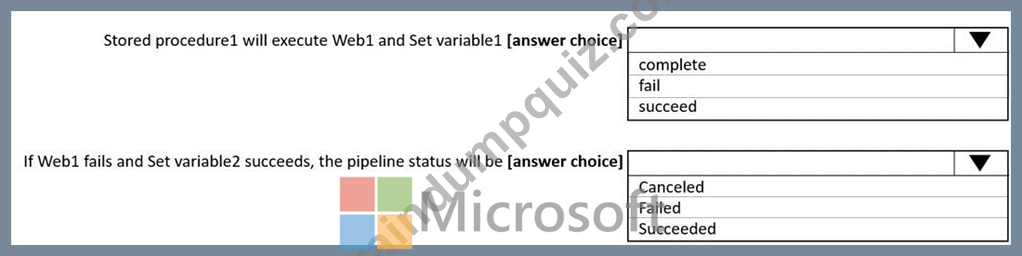
Answer:
Explanation:
Reference:
https://datasavvy.me/2021/02/18/azure-data-factory-activity-failures-and-pipeline-outcomes/
NEW QUESTION 134
Which Azure Data Factory components should you recommend using together to import the daily inventory data from the SQL server to Azure Data Lake Storage? To answer, select the appropriate options in the answer area.
NOTE: Each correct selection is worth one point.
Answer:
Explanation:
NEW QUESTION 135
You need to implement an Azure Databricks cluster that automatically connects to Azure Data lake Storage Gen2 by using Azure Active Directory (Azure AD) integration. How should you configure the new clutter? To answer, select the appropriate options in the answers are a. NOTE: Each correct selection is worth one point.
Answer:
Explanation:
Explanation:
https://docs.azuredatabricks.net/spark/latest/data-sources/azure/adls-passthrough.html
NEW QUESTION 136
You have an Azure Synapse workspace named MyWorkspace that contains an Apache Spark database named mytestdb.
You run the following command in an Azure Synapse Analytics Spark pool in MyWorkspace.
CREATE TABLE mytestdb.myParquetTable(
EmployeeID int,
EmployeeName string,
EmployeeStartDate date)
USING Parquet
You then use Spark to insert a row into mytestdb.myParquetTable. The row contains the following dat a.
One minute later, you execute the following query from a serverless SQL pool in MyWorkspace.
SELECT EmployeeID
FROM mytestdb.dbo.myParquetTable
WHERE name = 'Alice';
What will be returned by the query?
- A. a null value
- B. an error
- C. 0
Answer: C
Explanation:
Once a database has been created by a Spark job, you can create tables in it with Spark that use Parquet as the storage format. Table names will be converted to lower case and need to be queried using the lower case name. These tables will immediately become available for querying by any of the Azure Synapse workspace Spark pools. They can also be used from any of the Spark jobs subject to permissions.
Note: For external tables, since they are synchronized to serverless SQL pool asynchronously, there will be a delay until they appear.
Reference:
https://docs.microsoft.com/en-us/azure/synapse-analytics/metadata/table
NEW QUESTION 137
Note: This question is part of a series of questions that present the same scenario. Each question in the series contains a unique solution that might meet the stated goals. Some question sets might have more than one correct solution, while others might not have a correct solution.
After you answer a question in this section, you will NOT be able to return to it. As a result, these questions will not appear in the review screen.
You plan to create an Azure Databricks workspace that has a tiered structure. The workspace will contain the following three workloads:
A workload for data engineers who will use Python and SQL.
A workload for jobs that will run notebooks that use Python, Scala, and SOL.
A workload that data scientists will use to perform ad hoc analysis in Scala and R.
The enterprise architecture team at your company identifies the following standards for Databricks environments:
The data engineers must share a cluster.
The job cluster will be managed by using a request process whereby data scientists and data engineers provide packaged notebooks for deployment to the cluster.
All the data scientists must be assigned their own cluster that terminates automatically after 120 minutes of inactivity. Currently, there are three data scientists.
You need to create the Databricks clusters for the workloads.
Solution: You create a Standard cluster for each data scientist, a High Concurrency cluster for the data engineers, and a High Concurrency cluster for the jobs.
Does this meet the goal?
- A. Yes
- B. No
We need a High Concurrency cluster for the data engineers and the jobs.
Note:
Standard clusters are recommended for a single user. Standard can run workloads developed in any language:
Python, R, Scala, and SQL.
A high concurrency cluster is a managed cloud resource. The key benefits of high concurrency clusters are that they provide Apache Spark-native fine-grained sharing for maximum resource utilization and minimum query latencies.
Answer: A
Explanation:
Reference:
https://docs.azuredatabricks.net/clusters/configure.html
NEW QUESTION 138
You have the following table named Employees.
You need to calculate the employee_type value based on the hire_date value.
How should you complete the Transact-SQL statement? To answer, drag the appropriate values to the correct targets. Each value may be used once, more than once, or not at all. You may need to drag the split bar between panes or scroll to view content.
NOTE: Each correct selection is worth one point.
Answer:
Explanation:
Reference:
https://docs.microsoft.com/en-us/sql/t-sql/language-elements/case-transact-sql
NEW QUESTION 139
You have an Azure Databricks workspace named workspace1 in the Standard pricing tier.
You need to configure workspace1 to support autoscaling all-purpose clusters. The solution must meet the following requirements:
* Automatically scale down workers when the cluster is underutilized for three minutes.
* Minimize the time it takes to scale to the maximum number of workers.
* Minimize costs.
What should you do first?
- A. Create a cluster policy in workspace1.
- B. Enable container services for workspace1.
- C. Set Cluster Mode to High Concurrency.
- D. Upgrade workspace1 to the Premium pricing tier.
Answer: D
Explanation:
For clusters running Databricks Runtime 6.4 and above, optimized autoscaling is used by all-purpose clusters in the Premium plan Optimized autoscaling:
Scales up from min to max in 2 steps.
Can scale down even if the cluster is not idle by looking at shuffle file state.
Scales down based on a percentage of current nodes.
On job clusters, scales down if the cluster is underutilized over the last 40 seconds.
On all-purpose clusters, scales down if the cluster is underutilized over the last 150 seconds.
The spark.databricks.aggressiveWindowDownS Spark configuration property specifies in seconds how often a cluster makes down-scaling decisions. Increasing the value causes a cluster to scale down more slowly. The maximum value is 600.
Note: Standard autoscaling
Starts with adding 8 nodes. Thereafter, scales up exponentially, but can take many steps to reach the max.
You can customize the first step by setting the spark.databricks.autoscaling.standardFirstStepUp Spark configuration property.
Scales down only when the cluster is completely idle and it has been underutilized for the last 10 minutes.
Scales down exponentially, starting with 1 node.
Reference:
https://docs.databricks.com/clusters/configure.html
NEW QUESTION 140
You have an Azure Synapse Analytics dedicated SQL pool.
You need to ensure that data in the pool is encrypted at rest. The solution must NOT require modifying applications that query the data.
What should you do?
- A. Enable Transparent Data Encryption (TDE) for the pool.
- B. Create an Azure key vault in the Azure subscription grant access to the pool.
- C. Enable encryption at rest for the Azure Data Lake Storage Gen2 account.
- D. Use a customer-managed key to enable double encryption for the Azure Synapse workspace.
Answer: A
Explanation:
Transparent Data Encryption (TDE) helps protect against the threat of malicious activity by encrypting and decrypting your data at rest. When you encrypt your database, associated backups and transaction log files are encrypted without requiring any changes to your applications. TDE encrypts the storage of an entire database by using a symmetric key called the database encryption key.
Reference:
https://docs.microsoft.com/en-us/azure/synapse-analytics/sql-data-warehouse/sql-data-warehouse-overviewmanage-security
NEW QUESTION 141
You develop a dataset named DBTBL1 by using Azure Databricks.
DBTBL1 contains the following columns:
SensorTypeID
GeographyRegionID
Year
Month
Day
Hour
Minute
Temperature
WindSpeed
Other
You need to store the data to support daily incremental load pipelines that vary for each GeographyRegionID. The solution must minimize storage costs.
How should you complete the code? To answer, select the appropriate options in the answer area.
NOTE: Each correct selection is worth one point.
Answer:
Explanation:
NEW QUESTION 142
......
Microsoft DP-203 Exam Syllabus Topics:
| Topic | Details |
|---|---|
| Topic 1 |
|
| Topic 2 |
|
| Topic 3 |
|
| Topic 4 |
|
| Topic 5 |
|
Verified DP-203 Dumps Q&As - 1 Year Free & Quickly Updates: https://interfacett.braindumpquiz.com/DP-203-exam-material.html