

Get Special Discount Offer on JN0-223 Dumps PDF [UPDATED May-2025]
PDF Download Juniper Test To Gain Brilliante Result!
Juniper JN0-223 exam is designed to test the knowledge and skills of professionals who wish to demonstrate their expertise in automation and DevOps. Automation and DevOps, Associate (JNCIA-DevOps) certification is intended for individuals who are interested in pursuing a career in network automation, software development, and other related fields. JN0-223 exam covers a wide range of topics, including automation tools, programming languages, DevOps practices, and network protocols.
By passing the JN0-223 exam, candidates demonstrate their ability to work with Juniper automation tools such as Junos PyEZ, Ansible, and SaltStack. They also showcase their proficiency in DevOps practices such as continuous integration and deployment, automated testing, and infrastructure as code. The JN0-223 certification is ideal for network professionals who want to advance their careers in automation and DevOps, and it is a prerequisite for higher-level Juniper certifications such as the JNCIS-DevOps and JNCIE-DevOps. Overall, the JN0-223 exam is a valuable certification that can help network professionals stay relevant and competitive in today's rapidly evolving IT landscape.
NEW QUESTION # 10
Which statement about using Ansible with a Junos device is correct?
- A. An Ansible playbook is a set of tasks written in XML
- B. An Ansible agent must be installed and running on the Junos device
- C. Ansible modules are executed on the control server
- D. SFTP must be used to allow communication between the Ansible control server and the Junos device
Answer: C
NEW QUESTION # 11
What are two components of the Waterfall model of software development? (Choose two.)
- A. a short interval of time between releases
- B. a large volume of code changes between releases
- C. a small volume of code changes between releases
- D. a long interval of time between releases
Answer: B,D
NEW QUESTION # 12
Exhibit.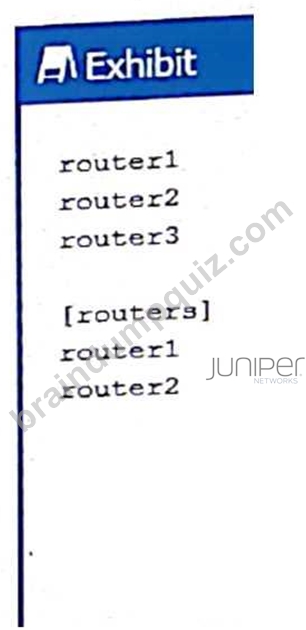
Referring to the exhibit, which statement about the Ansible host file is correct?
- A. Only router3 is included in the routers group
- B. router1 and router2 are included in the routers group.
- C. router1 and router2 are excluded from the routers group.
- D. All routers are part of the routers group.
Answer: B
NEW QUESTION # 13
Referring to the exhibit.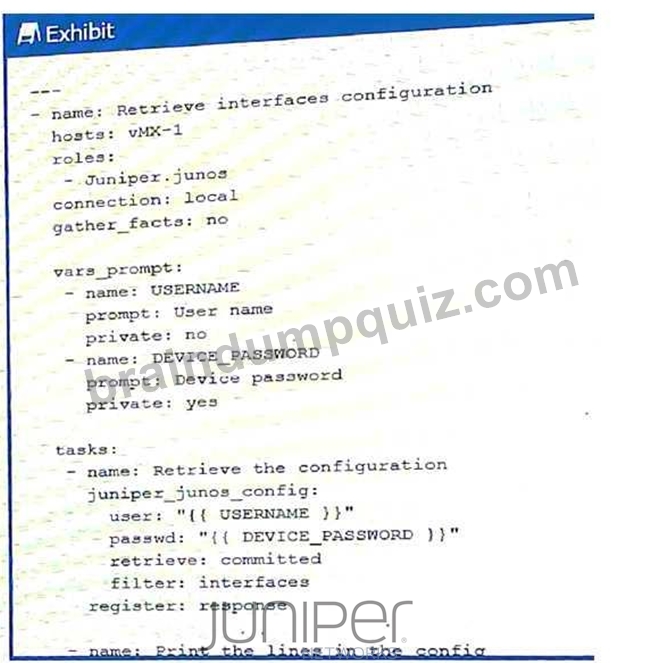
which two statements are correct? (Choose two.)
- A. The retrieved configuration will be from the Junos active configuration.
- B. The configuration will be retrieved in JSON format.
- C. The retrieved configuration will be from the Junos candidate configuration.
- D. The configuration will be retrieved in XML format.
Answer: B,C
NEW QUESTION # 14
Which two statements are correct about Junose PyEZ Tables and Views? (Choose two.)
- A. The Juniper_Junos_config module enables the use of PyEZ Tables and Views.
- B. PyEZ Tables and Views are defined using CSV.
- C. PyEZ Tables and Views are defined using YAML.
- D. The juniper_junos_table module enables the use of PyEZ Tables and Views.
Answer: A,C
NEW QUESTION # 15
Exhibit.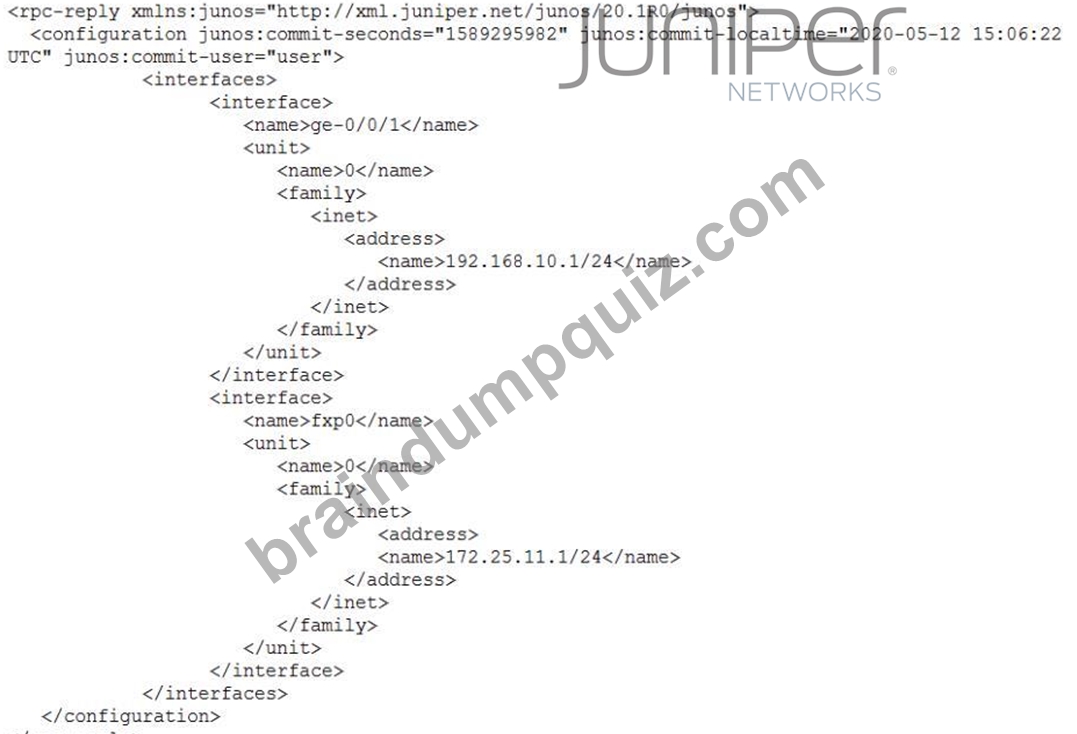
Referring to the exhibit, which XML XPath expression will only show the IP address XML elements?
- A. //name
- B. /name
- C. /address/name
- D. //address/name
Answer: D
Explanation:
https://www.w3schools.com/xml/xpath_syntax.asp
NEW QUESTION # 16
You must use Junos PyEZ to configure unique IP addresses on individual machines.
Which two features will permit this requirement? (Choose). Ian SCP module
- A. a YAML data file
- B. a BSON data file
- C. an SCP module
- D. a Jinja2 template
Answer: A,D
Explanation:
To configure unique IP addresses on individual machines using Junos PyEZ, you can use the following features:
YAML Data File (C): YAML files are used to store configuration data in a human-readable format. They are often used in combination with Jinja2 templates to provide the data necessary for template rendering.
Jinja2 Template (D): Jinja2 is a templating engine for Python that allows you to create dynamic templates. When used with Junos PyEZ, a Jinja2 template can be filled with data (such as IP addresses from a YAML file) to generate configuration snippets that are applied to different devices.
Options A (SCP module) and B (BSON data file) are not typically used with Junos PyEZ for this purpose.
Reference:
Junos PyEZ Documentation: Discusses the use of YAML files and Jinja2 templates for generating configurations.
Jinja2 Templating Documentation: Provides details on how to create and use templates in Python scripts.
NEW QUESTION # 17
Which two statements about XML schema definition (XSD) files are correct? (Choose two.)
- A. Every XML document must have an XSD file defined for it.
- B. XSD files define all the elements in an XML document and the document XML hierarchy.
- C. An XSD file is not an XML document.
- D. XSD files ensure that everyone working with the XML document uses a common set of tags.
Answer: B,D
Explanation:
XML Schema Definition (XSD) files are used to define the structure and data types of an XML document. They ensure that the XML document adheres to a specific structure by defining the allowed elements, attributes, and their data types, thereby enforcing a consistent format.
Option A is correct because XSD files define the elements, attributes, and structure (hierarchy) of an XML document.
Option D is correct because XSD files provide a standardized format, ensuring that all parties working with the XML document use the same set of tags and structure.
Option B (Every XML document must have an XSD file defined for it) is incorrect; not every XML document requires an XSD file, although it's beneficial for validation.
Option C (An XSD file is not an XML document) is incorrect because XSD files themselves are written in XML.
Supporting Reference:
W3C XML Schema Definition (XSD) Documentation: Explains the purpose and structure of XSD files, including their role in defining XML document schemas.
NEW QUESTION # 18
Which statement about the NETCONF content layer is true?
- A. It uses XML for RPC request and response payloads.
- B. It uses YAML for RPC request and response payloads.
- C. It uses HTML for RPC request and response payloads.
- D. It uses JSON for RPC request and response payloads.
Answer: A
Explanation:
The NETCONF protocol, used for network management, utilizes XML for encoding the RPC (Remote Procedure Call) requests and responses. XML is chosen because of its flexibility and ability to represent hierarchical data structures, making it well-suited for representing network configurations and states.
* Option Bis correct because XML is the standard format used for NETCONF RPC payloads.
* Options A (YAML), C (JSON), and D (HTML)are incorrect because these formats are not used by NETCONF for its RPC payloads.
Supporting References:
* RFC 6241 - NETCONF Protocol:This RFC describes the use of XML for encoding NETCONF messages.
NEW QUESTION # 19
Exhibit.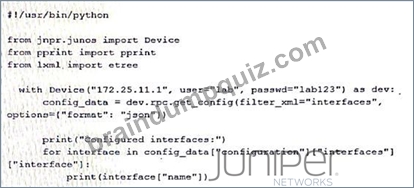
Referring to the exhibit, which two statements about the script are correct? (Choose two.)
- A. The script retrieves the interface configuration in XML
- B. The script prints the name of each configured interface.
- C. The script prints interface information for each interface name.
- D. The script retrieves the interface configuration in JSON.
Answer: B,D
NEW QUESTION # 20
Which Ansible Playbook play parameter will prevent the system from copying the playbook to the Junos devices?
- A. gather_facts
- B. environment
- C. serial
- D. connection
Answer: D
NEW QUESTION # 21
Which two statements about the REST API are correct? (Choose two.)
- A. The REST API application is stateful.
- B. The TCP session state is maintained by the server.
- C. The REST API application is stateless.
- D. The TCP session state is maintained by the client
Answer: C,D
Explanation:
REST (Representational State Transfer) is an architectural style for designing networked applications, and its key principles include:
Statelessness (B): Each request from the client to the server must contain all the information needed to understand and process the request. The server does not store any session state between requests, meaning each request is independent and does not rely on previous ones.
TCP Session State (C): While REST itself is stateless, the underlying TCP connection's state, such as keeping the connection alive or managing retries, is handled by the client. The server does not retain information about the TCP connection beyond the processing of the individual request.
Options A and D are incorrect because they imply that the REST API is stateful, which contradicts the stateless nature of REST.
Reference:
REST API Design Principles: Describes the stateless nature of REST and the responsibility of clients in managing session state.
Web Development Documentation: Discusses how REST APIs operate, focusing on statelessness and client-server interaction.
NEW QUESTION # 22
Which two statements regarding the DevOps methodology are correct? (Choose two.)
- A. Communication between people should be minimized during the process as much as possible
- B. Feedback should be analyzed at each stage of the process.
- C. Code changes should be few and manually tested.
- D. A goal is to make development, test, and production environments as identical as possible
Answer: B,D
NEW QUESTION # 23
YAML uses which two data structures? (Choose two.)
- A. arrays
- B. objects
- C. sequences
- D. mappings
Answer: C,D
Explanation:
YAML (YAML Ain't Markup Language) primarily uses two data structures:
* Mappings: These are key-value pairs, similar to dictionaries or hashes in programming languages. In YAML, mappings are used to represent associative arrays or objects. They are defined with a colon (:) separating the key from the value.
Example:
key: value
name: John Doe
* Sequences: These are ordered lists of items, equivalent to arrays or lists in other programming languages. Sequences in YAML are denoted by a dash (-) followed by a space and then the item.
Example:
fruits:
- Apple
- Banana
- Cherry
* Mappings(B) allow you to define relationships between keys and values, making it possible to represent more complex data structures like dictionaries or objects.
* Sequences(C) allow you to represent ordered collections, which is important for listing elements that must maintain a specific order.
Detailed Explanation:YAML is often used in configuration files and data serialization in DevOps environments, such as in Ansible playbooks, Kubernetes manifest files, and CI/CD pipeline definitions.
Its simplicity and human-readable format make it a popular choice for these applications.
* YAML Official Documentation: YAML's specification outlines these core data structures.
* Juniper Automation and DevOps Documentation: Provides best practices for using YAML in network automation scripts and configuration management.
References:
NEW QUESTION # 24
Which statement is correct about DevOps?
- A. DevOps is meant to define and restrict the development and operations tools used for a project.
- B. DevOps is a collection of strict guidelines that promotes the project completion over all other aspects.
- C. DevOps is a defined standard written and maintained by the IEEE standards group.
- D. DevOps is meant to unite the development, operations, and other teams to improve project collaborations.
Answer: D
Explanation:
DevOps is a set of practices, tools, and cultural philosophies that aims to integrate and automate the processes between software development and IT operations teams. The primary goal of DevOps is to shorten the systems development life cycle and provide continuous delivery with high software quality.
Option C is correct because DevOps fundamentally focuses on breaking down the silos between development and operations teams, fostering a collaborative environment where these teams work together throughout the entire software lifecycle. This collaboration extends to other stakeholders, including quality assurance (QA), security, and more, to ensure that the product is continuously delivered and improved based on real-time feedback.
DevOps promotes a cultural shift where teams are no longer isolated but work together to share responsibilities, which leads to increased efficiency, faster problem resolution, and a more streamlined deployment process. This culture of collaboration is supported by various automation tools and practices such as Continuous Integration (CI), Continuous Deployment (CD), Infrastructure as Code (IaC), and automated testing.
Supporting Reference:
Juniper Networks Automation and DevOps Documentation: This documentation emphasizes the importance of collaboration between development and operations teams to streamline processes and improve efficiency, aligning perfectly with the principles of DevOps.
"The DevOps Handbook" by Gene Kim, Patrick Debois, John Willis, and Jez Humble: This book provides an in-depth look into how DevOps practices enhance collaboration and lead to faster, more reliable software delivery.
IEEE and Industry Standards: While DevOps practices are widely adopted, they are not defined or maintained by IEEE or any other formal standards body, which is why option D is incorrect.
NEW QUESTION # 25
Your organization is developing an application to automate management of Junos network appliances. You want to use the existing PyEZ libraries to improve the development process. Which API would satisfy this requirement?
- A. JETAPI
- B. XML API
- C. REST API
- D. RPC API
Answer: C
NEW QUESTION # 26
Which two statements are correct about a Python dictionary data type? (Choose two.)
- A. The data stored in a dictionary data type is not sequenced or indexed.
- B. The data stored in a dictionary data type is sequenced and indexed.
- C. The data contained in a dictionary data type cannot be removed once the dictionary has been created.
- D. The data contained in a dictionary data type is a key/value pair.
Answer: A,D
Explanation:
A Python dictionary is a data type that stores data in the form of key/value pairs. It has the following characteristics:
* Key/Value Pair (C): Each entry in a dictionary is a pair consisting of a unique key and a value. The key is used to access the corresponding value.
* Not Sequenced or Indexed (D): Unlike lists or tuples, dictionaries do not maintain order for their entries (in versions prior to Python 3.7). Even though Python 3.7+ maintains insertion order, dictionaries are not considered indexed or sequenced in the traditional sense like lists, where elements are accessed via positional index.
Option A is incorrectbecause dictionary entries can be added, modified, or removed after the dictionary is created.Option B is incorrectbecause dictionaries are not accessed by a numeric index but rather by their keys.
* Python Official Documentation: Details the nature of dictionaries, including their mutability and key
/value structure.
* Python Data Structures Guide: Explains dictionary operations and characteristics.
References:
NEW QUESTION # 27
Which Python code block is an example of an context manager?
- A.

- B.

- C.

- D.

Answer: A
NEW QUESTION # 28
Exhibit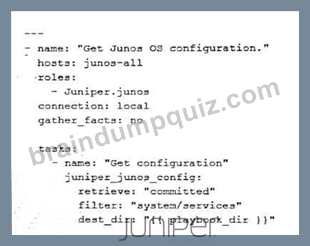
Referring to the exhibit, what will be two results of this playbook before saving it to a file? (Choose two.)
- A. to include everything but the system/services
- B. to retrieve the candidate configuration
- C. to include only the system/services
- D. retrieve the committed configuration
Answer: C,D
NEW QUESTION # 29
......
JN0-223 Dumps are Available for Instant Access: https://interfacett.braindumpquiz.com/JN0-223-exam-material.html